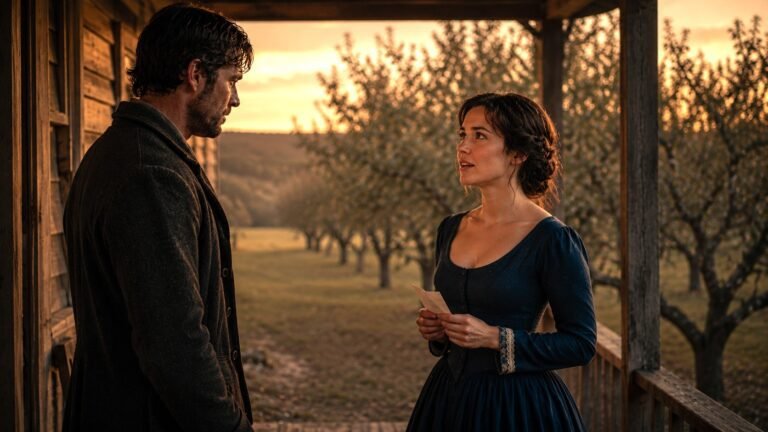

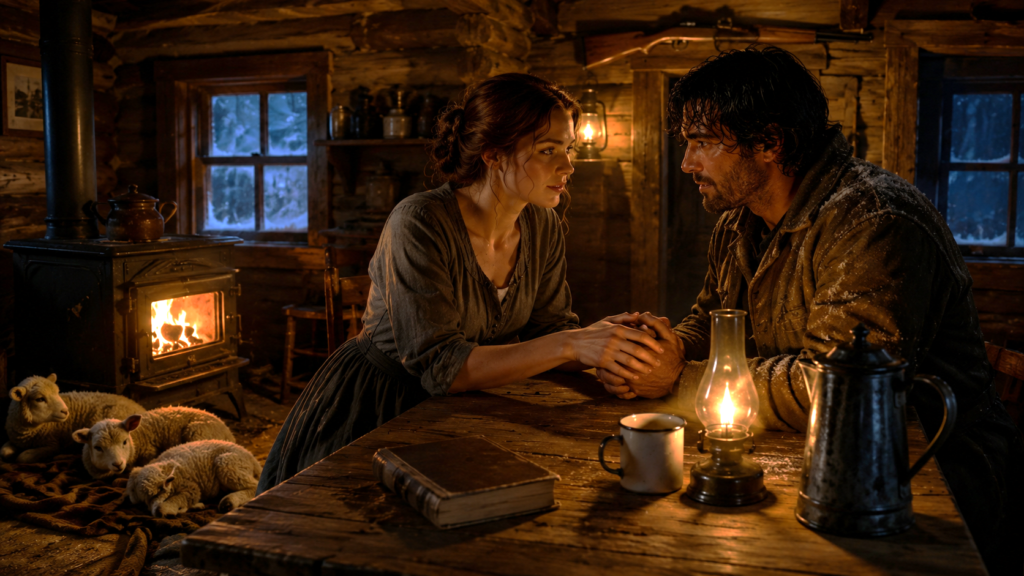
The coffee maker in Wes Calloway’s kitchen was older than his marriage had been, a Mr. Coffee with a cracked carafe handle mended twice with electrical tape, and every morning at five-forty it hissed and spat exactly the way it had for eleven years. He measured the grounds without looking — four scoops, always four, though there was no longer any reason for four — and while it dripped he stood at the window over the sink and watched the light come up gray and then rose-colored over the Bitterroot range, the same mountains that had been there before Ruth and would be there after everyone who remembered her was gone too.
He poured two cups.
He had stopped noticing that he did this. His hands did it the way his hands closed the chicken coop at dusk or checked the propane gauge on the tank behind the barn — not thought, just motion, muscle remembering a shape the mind had let go of. One cup he drank black at the counter, standing, because sitting down to coffee felt like an indulgence he hadn’t earned yet at that hour. The other cup he carried out to the porch, and there, without ceremony, without looking at it too long, he poured it over the rail into the dirt below, where three years of poured coffee had left the ground dark and faintly sweet-smelling even in dry August.
Etta was still asleep. She was eight, and she slept the way only children and the truly unburdened sleep, sprawled sideways across the bed with one foot hanging off, and Wes checked on her before he went out to the barn, the way he checked on her every morning, a habit that had less to do with Etta’s safety at this point and more to do with something in him that needed, daily, to confirm that the people under his roof were still there.
The ranch ran fourteen hundred acres of hay ground and pasture along Willow Creek, and Wes worked it mostly alone, with a hired hand named Dutch who came three days a week and a lawyer sister in Bozeman who called on Sundays to ask, in a voice too carefully casual, whether he was doing all right. He always said fine. He had gotten good at fine. Fine was a gate he kept latched.
He was a man who closed gates. Not just the pasture gates, though he closed those too, every one, every time, even the ones nobody but him would ever pass through again — the gate to the west forty where Ruth used to ride, the gate to the old orchard that hadn’t borne fruit worth picking in three years. He closed them out of a discipline so old it no longer felt like discipline. A gate left open let something out. Or let something in. He had stopped being sure which one frightened him more.
There was a second saddle in the tack room, a woman’s saddle, oiled and cared for and never sat in, hanging on its rack between the halters like something on display in a museum nobody visited. Dutch had asked once, early on, if Wes wanted to sell it, and Wes had said no in a voice that closed that particular conversation permanently, the way he closed everything.
Ruth had died on a county road eleven miles from the house, black ice in February, a delivery she hadn’t needed to make herself except that Wes had been in Billings for two days at a livestock auction and someone had to bring feed out to the calving heifers, and the someone had been her. He had not been there. That was the sentence his mind returned to on nights he couldn’t outrun it — not there — three words that had rearranged the entire architecture of what he let himself want.
He did not think of himself as broken. Broken implied an event, a single fracture, something you could point to and say, there, that is where it happened. What Wes carried was quieter than broken. It was closer to a habit of bracing, the way a man who has been thrown from a horse enough times starts, without deciding to, tightening his grip a half-second before the animal even shifts its weight. He had built a life that required almost nothing from anyone. He had built it carefully, the way he built fence — plumb, tight, capable of holding against weather. It held. That was the whole point of it. It held, and it asked nothing of him that he was not prepared to lose.
Etta came down at seven in socked feet, hair a wild dark tangle, and climbed onto the stool at the counter and ate her cereal while Wes made her lunch, and this too was a fixed point in the day, immovable, the one hour that felt less like survival and more like something a person might, if pressed, call good. She talked about a girl at school named Presley who had a horse that could count to ten by stomping its hoof, and Wes said that sounded like a smart horse, and Etta said Presley’s mom said Wes should come to the Founders Day auction on Saturday because they needed men to get auctioned off for chores, and Wes said absolutely not, and Etta grinned at him over her spoon in a way that meant she had already told Presley’s mom yes.
He drove her to school in the truck, the radio low on the AM station that gave grain prices and obituaries in the same flat, unhurried voice, and after he dropped her he sat for a moment in the school parking lot with the engine running, watching her disappear through the double doors with her backpack bouncing, and something moved through his chest that he did not examine, the way he did not examine the coffee poured into the dirt, the way he did not examine the saddle nobody rode. He drove home. He mended a section of fence along the county road where the wind had worked a post loose, tamping the dirt back around its base with the flat of a shovel, testing it with his shoulder until it held.
He had built a life that held. He told himself, driving the last mile home with the window down and the smell of cut hay coming off the Petersons’ field, that holding was enough. He had believed this for three years with the particular fierceness of a man who could not afford to believe otherwise.
By Saturday the belief had not moved an inch. Nothing in Wes Calloway’s life on that Friday night — checking the calving barn, pouring two cups of coffee out of a habit he’d stopped questioning, closing the gate to the west forty out of a discipline that had long since stopped feeling like grief and started feeling like character — gave any indication that anything was about to.
The Founders Day auction was held in the fairgrounds pavilion, a metal-roofed barn of a building strung with paper lanterns and lit against the early dark by a string of construction lights someone’s husband had wired up specially, and it smelled like fry bread and cut grass and the particular mineral sweetness of a Montana evening in September, cool enough now that people had brought jackets they wouldn’t need until the auction ended and everyone spilled outside.
Wes stood at the back near the folding chairs with his hat pushed back and a paper cup of bad coffee he wasn’t drinking, wearing the collared shirt Etta had laid out on his bed that morning with the seriousness of a stylist, and he watched Deacon Holt, three lots ahead of him, get auctioned off for a hundred and ten dollars’ worth of gutter cleaning to the Ferris sisters, who cackled about it from the front row like they’d won something better than gutters.
He had told Etta he would do this and regret it and she had told him that was fine, regret was allowed, and so he stood in line behind Marcus Reyes and in front of a kid named Tanner who did the auctioneer’s numbers in his sleep, and when the emcee — Loretta Simms, who ran the feed store and had known Wes since before he could ride — called his name, he walked up onto the little platform with the specific mortification of a man who has spent three years making himself invisible now standing under a string of lights while forty people looked at him.
“Wes Calloway,” Loretta announced into the microphone, grinning. “Fence work, hay hauling, general ranch labor, one full day. Comes with his own truck and, I am reliably told, decent manners. Who’ll start us at twenty-five?”
The bidding was slow and friendly, the way it always was, hovering around forty dollars from the usual crowd, until a voice from somewhere near the side entrance said, clear and unhurried, “A hundred.”
Heads turned. Wes turned too, and found the voice belonged to a woman he did not recognize, standing near the propane heaters in a coat too well cut for the fairgrounds, dark hair pulled back, watching the platform with an expression of frank, unembarrassed interest, as though she had wandered in off a different life entirely and found this one curious enough to stay for.
“A hundred dollars,” Loretta repeated, delighted. “We got a hundred from the lady by the door — ma’am, you know this includes actual fence work and not just the truck?”
“I’m aware,” the woman said, and there was a ripple of laughter, and Wes felt his face go hot in a way it had not gone hot in longer than he cared to measure.
Marcus Reyes’s wife bid a hundred and ten out of pure competitive reflex, and the woman by the door said, without raising her voice, “A hundred and fifty,” and that ended it, because nobody in this county was going to spend a hundred and fifty dollars to watch Wes Calloway dig postholes.
Her name, it turned out, standing in the gravel lot afterward while the band tuned up inside, was Vivian Ashworth, and she was the CEO of a renewable energy company that had been in talks with three ranch families along the creek — the Petersons, the Holts, and, as of a letter Wes had left unanswered in a kitchen drawer for two weeks, the Calloways — about leasing land for a wind survey.
“I didn’t know I was bidding on the man himself,” she said. There was something dry in it, self-amused, the voice of someone used to rooms where nobody laughed at her jokes because nobody was sure she was making one. “My assistant told me the local fundraiser was a good way to meet people before Monday’s meetings. I don’t think she meant this specifically.”
“You bought yourself a day of digging postholes,” Wes said. “That’s a hell of a way to meet people.”
“I’ve paid more for worse company.” She looked at him directly when she said it, and there was something in the directness that Wes was not prepared for — not flirtation exactly, or not only that, but a kind of assessment, as though she were used to deciding quickly whether a thing was worth her time and had already decided this was.
Saturday, then, at seven, because Vivian Ashworth turned out to be a woman who collected on her purchases.
She arrived in jeans that still had the crease of retail in them and boots clearly bought that week for exactly this purpose, and Wes handed her a pair of leather gloves off the tailgate and did not say anything about the boots, and for six hours they strung wire along the county-road fence line while the sun climbed and Wes explained the give and take of it, how you didn’t want it too tight or the posts would lean, how you read the ground for where the old fence had failed and asked why before you fixed it the same way twice.
She was terrible at it for the first hour and doggedly better by the fourth, and somewhere around noon, sweating through her ruined shirt with a smear of dirt along one cheekbone she didn’t know was there, she said, apropos of nothing, that she had once closed a four-hundred-million-dollar acquisition in a conference room in Singapore and had never once been as tired as this, and Wes laughed — actually laughed, a sound that surprised him coming out of his own chest — and said maybe that was because nobody in Singapore made her hold the wire stretcher.
At lunch, sitting on the tailgate with sandwiches Etta had insisted on packing an extra of, Vivian asked why he still had the second sandwich if Etta wasn’t there, and Wes said Etta packed lunches like she was provisioning for a siege, and Vivian said, watching him with that same unhurried attention, that Etta sounded like she’d raised him at least as much as the other way around, and Wes did not have an answer for that, only a feeling in his chest like a fence wire pulled a fraction too tight.
By late afternoon they had strung four hundred yards of new fence, and Vivian stood back from it with her hands on her hips, surveying the line the way Wes had watched boardroom photographs suggest she surveyed acquisitions, and said, “You know, you’d make a great bride.”
Wes looked at her.
“You’re patient,” she said, ticking it off, clearly enjoying herself now. “Good with your hands. Feed a person well. Extremely competent at physical labor in service of someone else’s project. I’m told those are the qualities people look for.”
“That an offer?”
“An observation.” But she was smiling, an actual smile, not the practiced professional one she’d arrived with. “I don’t think I’ve met anyone less interested in being managed. It’s refreshing. Most men my company deals with want to be handled. You just want to be left alone to do the work correctly.”
“That a compliment?”
“I would need a groom for that,” Vivian said — not answering him, or answering something else entirely, the joke sliding sideways off his and landing somewhere with more weight than either of them had planned for, and for a moment neither of them said anything, the wind moving through the new fence wire with a low singing sound, and Wes understood, standing there with dirt under his nails and the ghost of Ruth’s saddle six miles behind him in a dark tack room, that something in the last six hours had gotten in past a gate he had believed, with total confidence, to be latched.
Vivian drove back to town that evening with a sunburn and a folder of unsigned lease documents still sitting in her rental car, unread, and did not think once, on the whole drive, about the four-hundred-million-dollar deal in Singapore.
The lease negotiations gave them a reason, at first, and then the reasons stopped being necessary, though neither of them said so out loud. Vivian’s company needed survey access to the ridge above Willow Creek, and Wes owned the ridge, and so there were meetings — first at the county extension office with lawyers present, then, because the lawyers were slow and the season wasn’t, at Wes’s kitchen table with coffee and the actual maps spread out under Etta’s crayon drawings, which Vivian studied with the same seriousness she gave the survey lines.
She came out most Thursdays. She told herself it was efficiency. Wes told himself it was efficiency too, and neither of them examined the fact that the meetings had a way of running two hours longer than the documents required.
She was, Wes came to understand, a woman built along very exact lines, the way a good fence was built — everything plumb, everything load-bearing, nothing wasted. She ran a company of four hundred people and answered emails at eleven at night and had a corner office in Denver with a view she’d told him, once, she’d stopped looking at within the first month. She had grown up the daughter of a man who ran his first company into a second and third, larger each time, and who had missed, by her count, eleven of her birthdays and both her grandparents’ funerals, always somewhere on a plane toward something that mattered more. She did not say this to Wes directly. She said it sideways, the way people say the things that actually built them — “my father used to say a closed deal was worth more than an open door,” delivered while looking at the survey map instead of at Wes, and Wes, who had learned to hear the shape of a thing from the space around it, understood that she had spent a great deal of her life making herself indispensable because she had once watched what happened to the ones who weren’t.
He did not press. Pressing was not a thing he did, not with anyone, and least of all with a woman whose whole bearing suggested a person braced, at all times, for the moment someone would ask more of her than she believed was survivable.
They talked, on those Thursdays, in the way of two people circling a thing neither is ready to name. Vivian would say something about the wind survey and end up, three sentences later, talking about her mother’s silence at the dinner table those eleven missed years, and then catch herself and ask Wes a technical question about easements as though the door she’d opened had been an accident. Wes would explain fence lines and end up, without meaning to, telling her about the west forty, and Ruth’s name would sit in the sentence for exactly as long as it took to say and then he would change the subject to the calving schedule, and Vivian, watching him do it, never once asked him to go back.
That was, Wes thought later, the thing that undid him slowest and most completely — that she never made him. She let the silences stand. When he trailed off mid-sentence about the pasture Ruth used to ride, Vivian did not fill it, did not soften it, did not reach across the table. She simply let it be a silence, the two of them sitting inside it together, and something about being allowed to stop without being abandoned in the stopping felt, to Wes, like being handed something he had forgotten the shape of.
One Thursday in October, with frost already silvering the low ground by seven a.m., Vivian arrived early and found him on the porch with two cups of coffee, one in his hand, one on the rail, steam still rising off it in the cold. She watched him pick up the second cup and, without any particular ceremony, pour it out over the rail into the frost-blackened dirt below.
She did not ask about it. But the next Thursday, and the one after that, Wes noticed that he had started making the second cup a few minutes later than the first, instead of both at once, as though some part of him had begun, without his permission, leaving room for the possibility that the cup might be wanted before it was poured out.
She never asked him to explain the gate at the west forty either, the one he always closed and she’d once, walking the fence line with him, watched him detour four hundred yards out of the way rather than climb over. She noticed things. She did not name them. It was, Wes came to think, its own kind of tenderness — the choosing not to make a person perform their wound for you before you’d give them anything.
There was a night in November, unseasonably warm, when Etta had gone to a sleepover and Vivian stayed later than the lease required, and they sat on the porch steps with a bottle of the decent whiskey Wes kept for occasions that never came, and the conversation drifted, as it did, toward the edges of things.
“You never asked me to sign,” Vivian said, meaning the lease, though by then it had been sitting finished and unsent in her car for three weeks, and both of them knew she wasn’t only talking about the lease.
“Didn’t seem like the kind of thing you rush,” Wes said.
“Everything in my life gets rushed. It’s the only speed I know how to move at.” She turned the whiskey glass in her hand, not drinking it, watching the porch light catch the amber of it. “My father used to say hesitation is how you lose the deal.”
“This isn’t a deal.”
“No,” she said, quiet, looking not at him but out at the dark shape of the mountains. “It isn’t.”
He wanted, in that moment, to ask her what it was, then, if not a deal — wanted to ask outright the thing he had been circling for two months, the way he circled the west-forty gate, out of a caution so old it no longer registered as caution. But the question sat in his chest like a fence post not yet tamped, and he let it sit, and she let her half of it sit too, and they finished the whiskey talking about nothing — about Etta’s horse-counting friend, about a hawk that had been working the fence line all fall — and when she left that night, standing by her car in the cold with her keys already in hand, she looked at him for a long moment, and Wes looked back, and neither of them closed the distance, and both of them, driving away or standing on the porch respectively, understood exactly how much had just not happened.
Etta, twelve years old going on forty in the particular way of children raised too close to grief, said to her father over cereal one Saturday morning, apropos of nothing, “You pour her coffee before she even asks now.” Wes did not have an answer for that either. He only noticed, days later, that it was true.
The call came on a Tuesday in early December, while Wes was out repairing the water line to the calving barn before the ground froze solid, and Etta ran out to the fence line in her socks, breath fogging, to say Vivian’s assistant had phoned the house looking for her because Vivian wasn’t answering her cell, and something in the assistant’s voice, Etta reported with a child’s unerring instinct for the important detail, had sounded like an emergency.
Wes drove into town and found Vivian’s rental car still parked outside the extension office, and Vivian herself standing beside it with her phone against her ear, and even from thirty yards Wes could read the whole shape of it in the set of her shoulders — the stillness of a person receiving news that reorganizes a life.
The company’s board, it turned out, had been quietly negotiating a merger for four months, and the merger had cleared that morning, and the new combined entity needed someone to run its European operations out of London starting in January, and Vivian’s name, her father’s old company having been swallowed into the same conglomerate years before under circumstances that made the offer feel, to her, less like an honor and more like a summons she had spent her whole life training to answer.
Wes did not learn any of this that day. What he learned, standing across the gravel lot watching her end the call and press the heel of her hand briefly against one eye before her face resettled into its usual composed lines, was that something had shifted, and that she had not called him first.
She came to dinner that Thursday as always, and something in her was folded, careful, the particular carefulness of a person holding a decision she had not yet spoken aloud, and Wes, watching her push food around a plate she wasn’t eating, watching her phone light up twice with messages she silenced without reading, felt the old architecture of himself begin, without his permission, to reassert its shape.
He did not ask her what was wrong. He had never been a man who asked, and three years of practiced self-sufficiency did not undo itself simply because a woman had started letting him leave the second cup of coffee a little later each morning. Instead he watched her not-eat, watched her phone light up a third time, watched the careful folded quality of her, and something old and familiar closed over in his chest like a hand around a fence wire, testing its give.
Not there, the old sentence said. She’s already somewhere else.
He had built, across three years, a very precise understanding of what it looked like when someone he loved was already halfway gone before the leaving was announced — Ruth’s face, distracted, in the last week, thinking about the calving heifers instead of him, thinking about the thing that would eventually take her out onto that icy road alone. He did not know, could not have known, that Vivian’s distraction that night was the opposite of Ruth’s — was, in fact, Vivian trying and failing to find a way to say I don’t want the job if it costs me you without saying a sentence so large it terrified her more than the London office ever could.
“You’ve got somewhere else you need to be,” Wes said. It was not a question.
Vivian looked up, startled by the flatness of it. “There’s a — there’s a thing with the company. I need to think it through.”
“Sure.” He was already standing, already clearing the plates, already moving with the brisk economy of a man closing a gate before the weather turned. “Don’t let me keep you.”
“Wes—”
“It’s fine,” he said, and it was the same fine he’d been saying for three years, a gate latched so smoothly nobody watching would guess anything had shut. “You’ve got a company to run. I’ve got a ranch. We both know how those things work.”
She left earlier than usual that night, standing in the doorway a moment too long as though waiting for him to say something else, and he did not, and she drove back to the motel in town with the offer letter unread in her bag and a feeling in her chest she did not have a name for, only the old and terrible certainty, inherited from a childhood of watching her father choose the deal, that wanting to stay and being permitted to were two entirely different things, and that she had, once again, without meaning to, made herself into the kind of complication a good man closes the door on rather than the kind he opens it wider for.
Neither of them called the other for six days. Wes fed the second cup of coffee to the frozen ground each of those six mornings, no delay in the pouring now, the old rhythm reasserting itself with a speed that frightened him more than he let himself feel. Vivian signed nothing, flew nowhere, sat in a motel room two miles from a ranch she could not make herself drive back to, turning the unsigned offer letter over in her hands the way Wes once watched her turn a whiskey glass, waiting for a courage that felt, that week, entirely used up.
It was Etta who broke it, in the end, the way children sometimes cut straight through the fences adults spend years building. She rode her bike the two miles into town on a Saturday morning cold enough that her father would have forbidden it outright if he’d known, and she found Vivian’s rental car still parked outside the motel, and she knocked on the door in her stocking cap with the particular fearlessness of an eight-year-old who has decided an injustice is being allowed to stand.
“You didn’t sign the papers,” Etta said, when Vivian opened the door, startled, in a sweater with her hair down in a way Etta had never seen it. “Dad checked the mailbox every day.”
“Etta, does your father know you’re here—”
“He poured out the coffee again,” Etta said, as though this settled something, which, to her, it entirely did. “He does it fast now. Not slow like before. You made it slow.”
Vivian stood in the doorway of a motel room two miles from a life she had let herself, for three months, believe she might actually be permitted to want, and something in the flat, devastating logic of an eight-year-old broke something loose in her chest that four months of boardrooms and a lifetime of her father’s example had never managed to.
She drove Etta home in the rental car, bike in the trunk, and did not call ahead, and found Wes at the barn checking the water line he’d been repairing the day the offer came through, and he straightened when he heard the car, and his face did the thing it did — the careful, practiced fine — and Vivian did not let him finish latching it.
“I didn’t sign it,” she said, before he could say anything, before the gate closed all the way. “I’ve had the letter in my bag for six days and I haven’t signed it, and I’m not going to, and I need you to understand that I didn’t tell you because I didn’t know how to say the actual sentence, which is that I have spent my entire life being the kind of person who is easy to leave for something bigger, and I did not know, until I was standing in that motel room, that there might be a version of this where nobody has to choose the bigger thing, because the bigger thing might already be standing at a kitchen table with a lease he didn’t want signed either.”
Wes stood very still, the water line running cold over his bare hand, forgotten. “You didn’t call.”
“No.”
“Six days.”
“I know.”
“I thought—” He stopped. Started again, the words coming slower, harder-won, the way fence wire comes when the ground beneath it has frozen unexpectedly. “I thought you were already gone. I’ve been down that road before, watching somebody get distracted and quiet right before they leave, and I latched the gate on it before you’d even said a word, because that’s what I do, that’s the only thing I know how to do fast.”
“I’m not her,” Vivian said — she had never said Ruth’s name aloud before, had only ever let the space around it sit unfilled, and saying it now, gently, without being asked, was its own kind of courage. “I’m not going anywhere that isn’t toward you. But I need you to let me say that instead of guessing it from how fast you pour the coffee.”
Etta, still sitting in the rental car with the window down, watching this with the frank interest of a child observing weather, said, “Are you going to be my stepmom or not, because Presley wants to know for the party invitation.”
Something broke open in Wes’s chest — not the old break, not the familiar bracing ache, but something closer to a gate swinging wide on oiled hinges after years of only ever being latched — and he laughed, a real laugh, rough with everything underneath it, and Vivian laughed too, both of them undone in the cold morning light by an eight-year-old’s logistics.
He crossed the yard to her. He did not make a speech. He had never been a man for speeches, and this was not a moment that needed one. He took her cold hands in his cold hands, and said, low, only for her, “Come up to the house. I’ll make coffee.”
They walked up together, Etta trailing behind with the particular satisfaction of a child who has engineered an outcome, and in the kitchen Wes took down two mugs — not the good one and the second one, but two matched ones Ruth had never owned, ones he’d bought without thinking about it sometime in October — and he poured coffee into both, and he did not carry either one to the porch rail. He set one directly into Vivian’s hands, where it belonged, and their fingers overlapped around the ceramic for a moment neither of them hurried through, steam rising warm between them in the cold kitchen light, and outside the window the west-forty gate stood, for the first time in three years, unlatched and swinging gently in the morning wind.
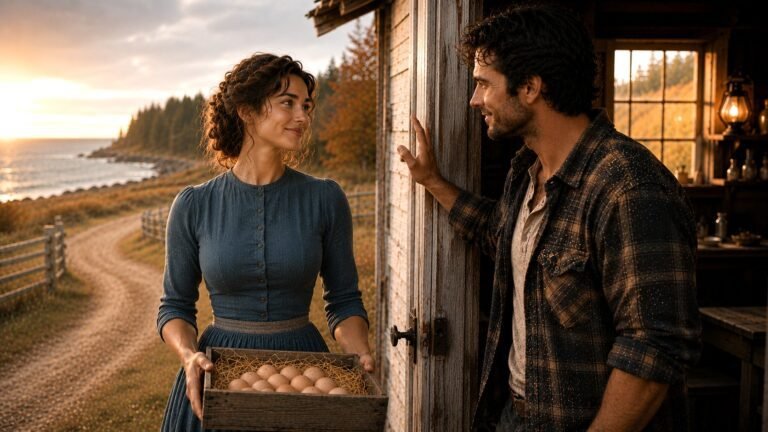
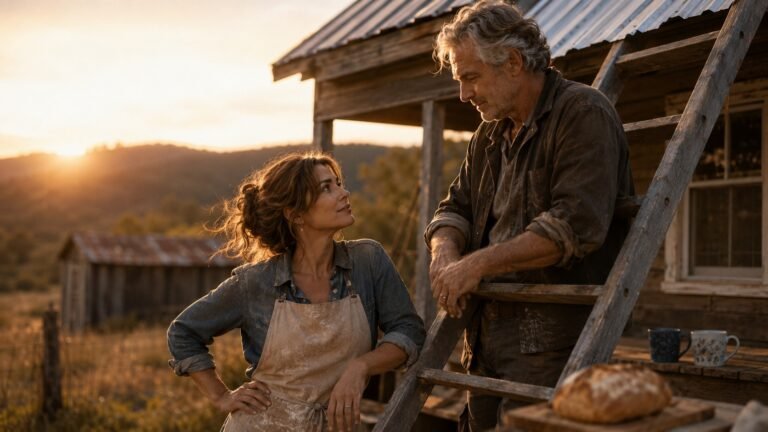
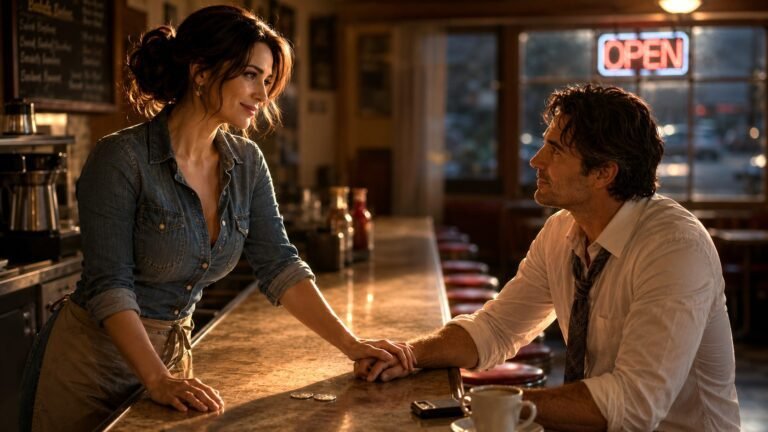
Heartfelt characters sharing love, emotions, and romantic journeys filled with hope, trust, and unforgettable bonds