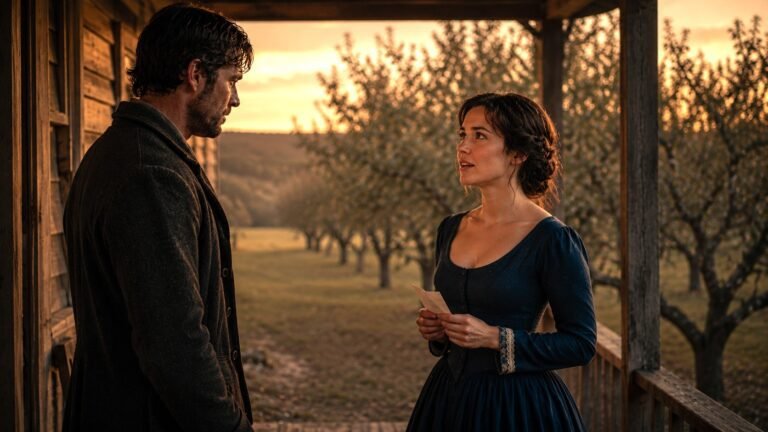

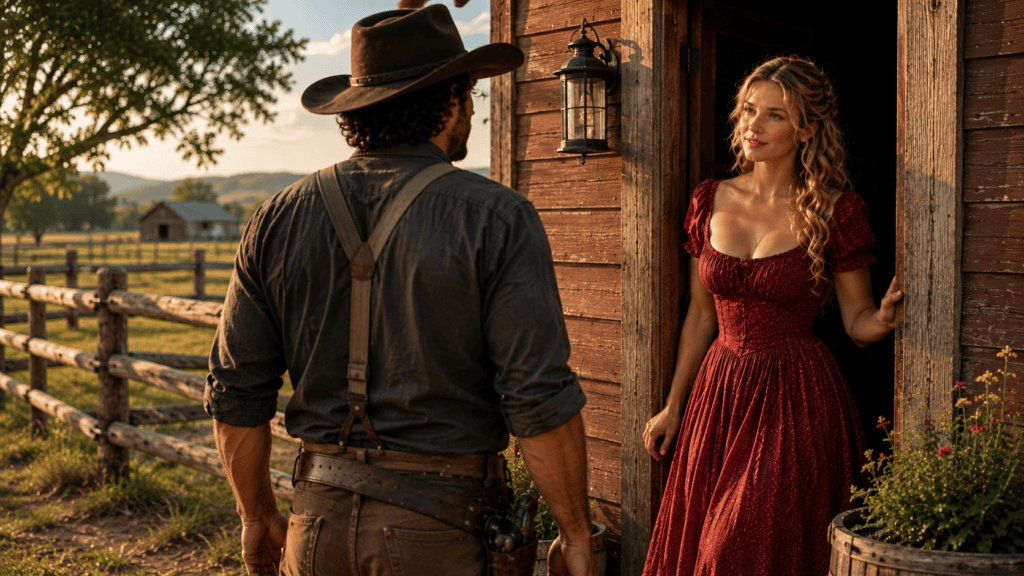
Thistle Harbor, Maine, 1923.
There is a particular kind of silence that settles over a man who has decided, without ever saying so aloud, that he will not be surprised by life again. Ezra Kane wore that silence the way other men wore their coats — without thinking about it, without taking it off even indoors.
He was thirty-two years old, and his hands had built more of Thistle Harbor than anyone cared to count. The Lindqvist trawler that still ran lobster pots out past Widow’s Ledge. The new steeple on the Congregational church, replaced after the ’21 storm took the old one down in splinters. Half the porches on Anchor Street, and every skiff that had ever needed a keel that would hold true in a following sea. When something needed building in Thistle Harbor, it needed Ezra Kane, and everyone in three townships knew it.
He showed up when called. He worked with a quiet, unhurried precision that made older men nod and younger men study him like a lesson. He went home when the work was done. He was esteemed by the whole harbor and known, in any real sense, by almost no one at all.
Five years earlier, he had been someone else. A younger man who whistled while he planed a board, who made plans the way other men made small talk, easily and often, plans with a shape and a future in them.
Her name had been Iris Calloway.
She was twenty-one, the only daughter of Samuel Calloway, who owned the cannery down on the point and half the fishing rights in the bay besides. She had auburn-brown hair that never quite stayed pinned, and a laugh that came without permission, the way weather came — sudden, total, impossible to prepare for. She had a way of looking at a person as if she had already decided to like them and was simply waiting to be proven right, and when she looked at Ezra Kane that way, he had felt, for the only time in his life, like the best version of himself was standing right there beside her, plain as daylight.
They were to be married in June of 1918.
He had been building her a boat.
Not a working boat — a proper sailing sloop, twenty-two feet at the waterline, with a curved sheer he’d drawn and redrawn a dozen times until it looked, to his eye, like something that belonged on the water rather than something merely floating on it. He meant it for their honeymoon, a slow week up the coast to the islands, just the two of them and the wind. He had named her — the boat — before he had cut a single plank, because Iris had insisted a boat without a name was bad luck, and she had chosen the name herself, laughing, daring him to argue.
The Iris Rose.
He had gotten as far as the hull, the ribs sprung and faired, the planking three-quarters done, when the influenza came to Thistle Harbor in the autumn of 1918, the way it came to every harbor town on the eastern seaboard that year — fast, indifferent, and entirely uninterested in what it interrupted.
Iris took sick on a Monday. A fever, an ache behind the eyes, nothing at first that seemed different from the ordinary run of things. By Thursday her lips had gone faintly blue at the edges and her breathing had a sound in it that the doctor, when he came, would not meet anyone’s eyes about. By the following Tuesday, she was gone. She was twenty-one years old, and she had been dead eleven days short of six months before their wedding.
Ezra sat beside her bed for a long while after, in a room gone very quiet, with the November dark pressing at the window glass. He looked at her face — the face he had been looking at since they were seventeen — and understood, all at once and completely, the way you understand a wave has already broken over you, that the future he had spent two years building in his mind had, in the space of a week, become nothing but the past.
He did not leave his house for six days. When he came out, he went back to work, because it was the only thing he knew how to do with his hands that did not involve them shaking.
He never touched the sloop again. He hauled her, half-planked and silent, into the far bay of his boat shed, and one evening in the spring of 1919, without quite deciding to, he threw a canvas tarpaulin over her hull and did not take it off again.
Five years is a long time to grieve and a short time to stop.
Ezra had not stopped, not exactly. He had learned to carry it the way a man learns to carry something too heavy to set down — not by putting it aside, but by shifting his grip on it so he could keep walking. He had always been the best craftsman on the harbor. In the years after Iris, he became something more exacting than that — the kind of builder who understood, in his bones, that the things he made would outlast him, and who poured that understanding into every seam and rivet as though it were a kind of penance.
He lived alone in a shingled house above the boatyard, small from the road but true in every joint inside it — the shelves level, the doors hung so they closed with a soft, satisfying click, the kitchen table solid enough to serve three more generations than his own. He was not unkind. He was, if anything, generous — with his time, with his skill, with the credit he extended to fishermen who couldn’t pay him until the season turned. But there was a quality to him that the whole harbor recognized without ever naming it: a door that stood open for business and shut, gently and completely, for everything else.
Mrs. Odette Bell, who ran the general store and had known him since before Iris, had long since stopped trying to seat him next to any of the harbor’s eligible young women at church suppers. He’s a good man who had something taken from him that doesn’t grow back the same, she told people, with the flat, unsentimental accuracy of a woman stating a fact about the tide. People nodded. They hired him. They left him be. It had seemed, for five years, like enough.
Ezra had told himself it was enough. He was not entirely certain he believed it. But believing otherwise meant opening a door he had gone to considerable trouble to close, and there are some doors that, once you understand what closing them cost you, feel impossible to open again — not because the hinge is broken, but because you’re no longer sure your hands remember how.
He knew, better than most men, that a joint held together by fear instead of fit would fail eventually. He had simply never examined whether that lesson applied to anything but wood.
Josephine Marsh arrived in Thistle Harbor on a blustery Wednesday in September, on the coastal steamer from Boston, with two trunks, a hatbox stand, and the particular, unhurried certainty of a twenty-year-old woman who has decided exactly what she means to do with her life and does not intend to be talked out of it.
She had trained under a milliner on Newbury Street since she was fourteen — her mother’s trade before her, and her grandmother’s before that — and she had come north with a plan as specific as a ship’s manifest: lease the empty storefront beside the general store, open by the first frost, build a clientele of harbor wives and captain’s daughters through the long winter, and be turning a profit by spring. She had auburn hair that drew glances without asking for them and a directness in her green eyes that suggested she had decided, long ago, that other people’s opinions of her were not her problem to manage.
Ezra was mending the hinge on the general store’s storm door when her trunks came off the wagon. He looked up once. He looked back down at the hinge. But something in him — something that had gone very quiet five years before — noticed, and then went quiet again, though not quite in the same way as before.
She needed him within three days. A shelf bracket in her new shop had come loose from the plaster — shoddy work by the previous tenant — and she couldn’t hang her ribbon spools without it. Mrs. Bell sent her down to the boatyard.
She found him at his bench, planing a length of oak for a door panel, sawdust curling gold in the afternoon light. He looked up with the expression he kept in reserve for strangers — polite, professionally present, entirely closed.
“Mr. Kane?”
“That’s right.”
“Josephine Marsh. I’ve taken the shop next to Mrs. Bell’s. I have a bracket that’s given up on me, and I understand you’re the man to see.”
He set down the plane. He looked at her the way he looked at a board before he cut it — assessing, unhurried. She looked back without flinching, the way she seemed to look at everything.
“I can come Thursday,” he said.
“Thursday will do.” Her gaze moved past him, over the tools racked in careful order along the wall, the clean sweep of the bench. “You built this shop yourself?”
“I did.”
“It’s very well made.” She said it plainly, the way you’d note the weather — not flattery, just fact.
He looked back at the bench rather than at her. “Thursday,” he said again.
She nodded and left. He stood there a moment longer than the moment required, looking at the oak, before he picked the plane back up. He did not think, on his walk home that evening, about the way she had studied his shop like someone who understood exactly what a well-made thing cost to build.
He thought about it for the rest of the night instead.
The bracket took him twenty minutes. She had coffee waiting when he arrived — strong, with a little cinnamon in it, which he had never had before and did not mention liking, though he finished the cup. She watched him work with the quiet attention of a person who watched most things closely. He fixed the bracket, checked the others while his tools were out, found two more that wanted tightening, and did those without being asked.
“You did the others too,” she said, not quite a question.
“They’d have come down eventually.”
She paid him less than the work was worth. He didn’t correct her. He left with the taste of cinnamon still on his tongue and told himself, walking back down Anchor Street with the harbor gulls wheeling and complaining overhead, that this was simply a man doing his trade.
The following Tuesday, the shop door wouldn’t latch. He came Wednesday and found the frame slightly out of true — nothing urgent, but the kind of small wrongness that would cause trouble by winter if left alone. He fixed it. The week after, a window sash that stuck. Then a floorboard with a give in it he didn’t like the sound of. Then a shelf in the back room that wanted a truer bracket than the last one.
He began to notice, with the same precision that let him tell a green board from a seasoned one at a glance, that the things wanting his attention arrived at suspiciously even intervals — once a week, always something small, always something that could, in honesty, have waited a month.
He said nothing about it. He came when she sent word, fixed what needed fixing, drank the coffee that was always hot when he arrived, and found himself, somewhere in October, having conversations he hadn’t had with anyone in five years — about the harbor, about her shop, about a novel she was reading that he’d never heard of, about the particular gold color the light took on over the water in the last hour before dusk, which she had opinions about, precise and considered opinions, the way she seemed to have opinions about everything that mattered to her.
He had never once discussed the quality of the evening light with another living soul.
He went home after each visit, looked at the shrouded shape of the sloop in the far bay of his shed, and thought: this is not what it looks like. And then: I ought to stop coming when she sends for me. And then, unbidden and immediate: that window frame on the harbor side of her shop will let the weather in by January if it isn’t reinforced before the first hard frost.
He did not examine, that October, the order in which those thoughts arrived.
He had not dreamed of Iris in nearly two years. In the first year after she died, she had come to him almost nightly — not the sickroom, never the sickroom, but the before: porch evenings, the smell of her mother’s kitchen, the particular sound of her laugh arriving before she’d finished the joke. He had woken from those dreams each time with the specific grief of a man who has been somewhere good and been dragged back out against his will.
Gradually, they had stopped coming.
On a Thursday in late October — the same day he’d shored up the harbor-side window frame at Josephine’s shop — Iris came to him again.
Not the way grief usually brought people back, anxious and unfinished. She came the way she had always come in life: easy, sunlit, the laugh sitting just behind her eyes, waiting. She was sitting on the deck of a half-built sloop under full sail, though the boat had never once left the shed, and she looked exactly as she had at twenty-one.
“Ezra,” she said.
“Iris.”
She studied him the way she used to when she had something to say that he wouldn’t want to hear and meant to say it anyway.
“You’re being very careful,” she said.
“I’m always careful.”
“With planking. Not with yourself.” She tilted her head. “You’re careful the way a man is when he’s afraid something won’t hold this time.”
He looked away, toward a shoreline that wasn’t there. “I know what happens when it doesn’t.”
“She looks at you,” Iris said, “the way I used to look at you.”
He said nothing.
“I always wanted you to build something with no purpose at all,” she went on, her voice as warm and unhurried as it had been in life. “Not a boat for hauling pots. Not a house to keep the weather out. Something just because it was beautiful. You’ve spent five years building things for everyone in this harbor but yourself. Build something for you.”
“I don’t remember how.”
“You do,” she said, and smiled — the smile that had always arrived without asking permission and changed the whole room when it did. “You’ve always known how. You only stopped believing you were allowed to.”
He woke at four in the morning with the Maine dark pressing close and cold against the window and the shape of the shrouded sloop just visible through the doorway to the shed. He lay still a long time. Then he rose, put the kettle on, and sat at his kitchen table with a cup of tea going cold in his hands, thinking about something built for no reason but beauty. For the first time in five years, the thought did not hurt.
It felt, instead, like permission.
The Thistle Harbor Regatta fell on the second Saturday of October, the way it had for forty years — the whole town down at the waterfront for the boat races, the chowder tent, the fiddler who played the same six reels every autumn and was beloved for it. Josephine had a booth at the edge of the green, a small display of her autumn hats arranged on a stand Ezra had built for her the previous Tuesday — not because she’d asked, but because he’d seen her struggling with two dressmaker’s forms and a length of twine and had simply arrived the next morning with something better. She had looked at the stand, then at him, and said nothing at all, which had been its own kind of sentence.
Her booth did well. Six weeks in Thistle Harbor and she’d already built half a clientele, partly on the strength of her work and partly because people were drawn to her the way they were drawn to a lit window on a cold street.
Ezra came to help rig the race committee’s signal flags, which was reason enough, and told himself it was the only reason. He finished by noon. He should have gone home.
He was at the edge of the green when he saw her — Josephine, surrounded by four young men of the harbor, sons of captains and cannery men, all competing for her attention with the particular clumsy confidence of young men who haven’t yet learned that confidence isn’t the same as being wanted. She was handling it the way she handled most things: warm, direct, entirely in command of the moment. She laughed at something one of them said — the real laugh, the one that arrived without warning.
Ezra looked down at his own hands.
Then he found himself walking toward her booth without any memory of having decided to.
She saw him before he arrived, the green eyes finding him easily across the green. He looked at her. He looked, briefly, at the four young men, who had noticed him now too, the way young men notice a rival even when they can’t quite say why he counts as one. He felt something in his chest he recognized and had not expected to feel again in this lifetime.
He offered the half-smile he kept for moments when he was feeling something he had no intention of saying outright.
“You’re going to break a lot of hearts around here,” he said. He meant it, mostly, as a way of saying something that wasn’t the thing he was actually thinking.
Josephine looked at him for a long moment — the young men still there, still talking, entirely forgotten. The quiet stretched just long enough to mean something. Then she smiled, not the wide laugh this time but something quieter, something that carried more weight for taking up less room.
“I only wanted to mend yours,” she said, looking at him and no one else.
And then she turned back to her booth and helped a fisherman’s wife choose between two shades of ribbon, as though she hadn’t just said the truest thing she had ever said to another human being.
Ezra stood at the edge of the green with four young men who were also, suddenly, standing very still, and every one of them was turning the same six words over, and only Ezra understood what they had actually meant.
He stood there a long while. Then he walked home along the water, and that night he did not sleep at all.
He sat at his kitchen table until the lamp burned low, the shrouded sloop a pale shape through the open shed door. He thought about what Josephine had said, and about what it would cost to let it mean what it meant — about what happens to a man who lets something matter again and then loses it a second time. He had already paid that particular price once. He knew its exact weight, the way he knew the weight of good oak versus poor, by feel alone. It was not a memory. It was a stone he carried in his chest and had learned to walk around but never once set down.
He thought of Iris, of the dream, of you only stopped believing you were allowed. He thought of Josephine’s green eyes finding him across a crowded green without hesitation.
And then he thought: I know exactly what a sound hull looks like, and I know what this is. And directly on the heel of that thought, with the terrible logic of a frightened man: that is exactly why I cannot risk it.
He rose before dawn and began, quietly and with the same methodical precision he brought to everything, to pack a single case.
A shipyard in New Bedford had written to him in August, offering a season’s work fitting out racing yachts — good money, twice what he’d see in Thistle Harbor in two years, and he had turned it down without a second thought because he hadn’t wanted to leave the harbor. He wrote to them now. He would go before the first snow. He told himself he was leaving because Josephine Marsh was twenty years old and deserved a man who could give her everything, without the stone he still carried in his chest. He told himself leaving was the generous thing, the honest thing.
He left the sloop where she stood, under her tarpaulin, exactly as she had stood for five years.
He sat down at his desk and began a letter to the New Bedford yard, confirming he would take the position. He wrote three lines. Then he stopped.
He looked across the room at the shape of the boat under canvas. He thought of Iris’s voice in the dream: you’ve always known how, you only stopped believing you were allowed.
He set the pen down. He picked it back up. He finished the letter, sealed it, and left it on the desk to post in the morning. Then he lay in the dark and listened to the wind working at the shingles and told himself, over and over, that this was the right thing to do, until the repeating of it began to feel almost like truth.
It felt like the right thing the way closing a door always feels right — until you are standing on the far side of it, and the latch has caught, and there is no handle on your side at all.
He left on the Tuesday steamer before most of the harbor had lit its stoves. He told no one but Mrs. Bell, from whom he bought traveling supplies and who looked at him with the expression of a woman who has watched a story unfold for weeks and finds this particular ending entirely unsatisfactory.
“New Bedford,” he said, before she could ask.
“Work,” he added, though she hadn’t asked that either.
“Mm,” said Mrs. Bell, and the single sound carried more disapproval than a full sermon could have managed.
Josephine learned of it Wednesday, when she came to send word about a hinge and found the boatyard shut and cold. Mrs. Bell told her plainly, the way she told most things. Josephine walked home along the water and said nothing to anyone about what she felt. She sat at her worktable that evening and finished trimming a hat with stitches so precise they might have been laid with a ruler, and did not once look up from the work.
On Thursday she went back to the boatyard, because Mrs. Bell had a spare key and thought she ought to see. On his workbench, set square in the center as though placed there with great care, sat a small wooden box, its corners joined with Ezra’s unmistakable, exacting precision. Inside it lay a single carved wooden rose, no bigger than her thumb — a thing with no use in the world except to be looked at.
No note.
Josephine held the little carved rose for a long time in the sawdust-and-oak-scented quiet, the same smell she had spent six weeks inventing small emergencies to be near. She turned it over in her palm, tracing the fine work of the petals, each one shaped with the same care he gave a keel that had to hold in heavy weather.
He had left it without a single word and gone to New Bedford.
She did not know whether it was a goodbye or the unfinished beginning of something he did not yet have the courage to say plainly. She put the rose in her coat pocket, went back to her shop, and returned to her work. She was twenty years old, and she had said the truest thing she had ever said to another person, and he had left anyway, and the not-knowing sat heavier in her than the leaving itself.
New Bedford was larger and louder than Thistle Harbor, full of masts and rigging and the constant clatter of a working port. The commission was real, the pay generous, and the work good — fine yachts, fine joinery, precise and demanding in a way that suited a man determined not to think about anything in particular. Ezra worked twelve hours a day and told himself, each night, that he was fine.
He was not fine.
He woke at three in the morning on his twelfth night away, the unfamiliar city dark around him, thinking about a small carved rose left without a note, wondering whether she had found it, wondering what she had made of the silence that came with it. He thought about the sloop still standing shrouded in his shed, half a decade unfinished. He thought of Iris in the dream. You only stopped believing you were allowed.
He thought about what it meant that he had carved, with his own hands, a thing with no purpose but beauty — exactly what Iris had asked of him — and had then left it on a bench like a man who had almost said something important and lost his nerve at the very last moment and run from the rest of it.
He sat up in the dark. He thought about everything he had ever built — every hull, every porch, every steeple — all of it, every board of it, built for other people, because he had stopped believing, five years before, that he was permitted to build anything for himself.
He thought of Josephine at her worktable, precise and quiet, never once performing her feelings for an audience, only living them plainly, the way she lived everything.
He thought: what kind of man leaves a rose and a silence and calls that enough?
He lit the lamp. He sat at the small desk in his rented room and wrote to the shipyard owner, explaining honestly that a matter of some importance required his return to Thistle Harbor, and that he would send along the name of another good joiner to finish the season in his place. He packed his single case before the sun was fully up, settled his account, and had his horse saddled by the time the harbor bells rang six.
He rode north for two days, thinking the entire way about what he meant to say when he arrived, about Iris and about permission and about a carved rose that deserved, at minimum, the words that ought to have gone with it. Somewhere on the second day, with the Maine coastline opening up ahead of him in the pale autumn light, he felt something rise in his chest that he recognized at once — the same feeling he’d had at twenty-six, riding home toward a future he was building with somebody. He had not felt it once in the five years between. He rode faster, into it, rather than away.
He reached Thistle Harbor on a Thursday afternoon, three weeks and one day after he’d left it. He tied his horse outside the general store and went in first, because some part of him needed the ordinary weight of Mrs. Bell’s disapproval before he could manage anything harder.
She looked up from the counter and studied him a long moment.
“You came back,” she said.
“I did.”
“Mm.” This time the single syllable carried something different — something closer to about time.
“She’s at her shop,” Mrs. Bell added, before he’d found a way to ask.
He walked down Anchor Street with his hat in his hands, past the storm door he’d mended in September, past the harbor-side window he’d shored against the winter that hadn’t arrived yet. The bell above her shop door rang the same small, bright note it always had. She was at her worktable with her back to him, threading a needle with the focused stillness of someone who had spent three weeks being very deliberate about staying occupied.
“One moment,” she said, not turning.
Then she heard the particular quality of the silence behind her — different from the ordinary quiet of the shop — and turned.
She looked at him standing in the doorway, hat in hand, three weeks of hard riding and harder thinking written plain across his face. The October light came through the window he’d fixed and lay across the floor between them.
Neither spoke for a long moment. Then she rose — not composing herself, already composed, with the settled stillness of a woman who had spent three weeks deciding how she would feel if this day ever came, and had arrived, finally, at an answer.
“Ezra,” she said.
“I left a rose,” he said, which was not at all what he’d planned to say first.
“I found it.”
“I should have left words with it. I should have—” He stopped, started again, plainer this time. “I left because I was afraid. Not of you. Of what it means to let something matter, and then lose it again.” He turned the hat once in his hands. “I lost someone, five years ago. Her name was Iris. I loved her, and she died, and I built a door around it and told myself keeping it shut was the responsible thing.”
“I know,” Josephine said quietly. “Mrs. Bell told me some of it. I worked out the rest myself, sitting here with your rose in my pocket for three weeks.”
“I carved you something with no purpose but to be beautiful,” he said. “And then I left it without a word and ran to New Bedford because I lost my nerve at the very last moment.”
He looked up and met her eyes directly.
“I’m not afraid anymore. Or I am — but I’ve decided I’m done letting it choose for me.”
She crossed the small shop with the same unhurried certainty she brought to everything, and stopped close in front of him.
“I’m not trying to take her place,” she said. “I’m not asking you to forget her. She was real, and she mattered, and she always will.” Her voice held steady, her eyes bright and clear. “I only want to be here, Ezra Kane, if you’ll let me.”
He looked at this twenty-year-old woman standing before him with nothing but plain truth in her face, and felt something in himself — something shut very tightly for a very long time — begin, not all at once, but truly, to open.
He reached out and took her hand. She looked down at it, at his fingers around hers, and then up at him, and she cried without any performance in it at all, the particular unguarded way a person cries when something they’d quietly given up on turns out, after everything, to still be true.
He held her hand and said nothing further, because there was nothing better to say than what was already happening in the silence between them.
He took her out to the boatyard on a Sunday, to see the sloop.
He had not taken the tarpaulin off in five years. He had built his whole life in the shadow of that covered shape without once being ready to look at it plainly. Josephine sat beside him on the shed floor while he worked the ropes loose, and when the canvas came away, the boat was simply what she had always been — a sloop begun by a young man for the woman he intended to marry, her ribs sprung true, her planking smooth and three-quarters finished, built to outlast the both of them.
He climbed aboard. Josephine followed. Tucked beneath the aft seat, wrapped in oilcloth gone soft with age, he found a small tin box he had forgotten entirely — Iris’s mending kit, a few pressed sea lavender blossoms gone brittle and pale, and, folded at the bottom, a single sheet of paper in her handwriting.
His hands were not quite steady. Josephine laid hers over them.
He unfolded it. It was a list — a list of things Iris had wanted for their honeymoon voyage, small and specific: sandwiches wrapped in wax paper, the good wool blanket, stop at every island whether we need to or not. And at the very bottom, underlined twice in her decisive, looping hand: sea roses along the bluff at home, not for cutting, not for anything — just because they’re lovely.
Ezra looked at the list a long while. Then he folded it with care and set it back inside the box — not as something to hide from any longer, but as something to keep, plain evidence of a life that had been real.
“She would have liked you,” he said finally.
“I think I’d have liked her,” Josephine answered.
He nodded, and looked out through the open shed doors at the gray autumn water.
“I’m going to finish her,” he said, meaning the boat, “and I’m going to plant sea roses along the bluff. Not for cutting. Just because they’re lovely.” He turned to Josephine. “If you’ll help me pick the color.”
She looked at him with the same green eyes that had found him, unerring, across a crowded green in October.
“Yes,” she said, simply, completely — the same way she said everything that mattered.
They were married the following spring, a small wedding by Thistle Harbor standards, because Ezra had never much cared for a crowd and Josephine had decided the only part that truly counted was the moment they said the words. They said them at the Congregational church, under the steeple he had rebuilt himself, with most of the harbor packed into the pews regardless — the whole town, it turned out, had been quietly invested in this particular outcome for months. Mrs. Bell wept in the front row with the deep satisfaction of a woman whose long-held judgment had finally been proven correct.
Ezra finished the sloop that summer, in the long evenings after his other work was done. He kept her name. On a bright morning in July, with half the harbor watching from the dock, he and Josephine took The Iris Rose out past the breakwater under full sail for the first time in five years and a lifetime, and the boat, when the wind found her properly, ran as true and as sweetly as he had always known she would.
He built their house that same summer — not the house he’d once drawn for Iris, but something new, entirely their own, with a south-facing kitchen for the light and a wide porch with room enough for two chairs and a long view of the water. Along the bluff behind it, he cleared a strip of ground and planted it with sea roses, not for cutting, just because they were lovely, and Josephine tended them through every season with the same careful attention she gave her ribbons and her ledgers and, eventually, her children. In the front hall of the house, on a shelf he built specifically to hold it, sat the small tin box with Iris’s list inside — not hidden, not a shrine, simply present, the way things that were real and had mattered were allowed to be present.
Their first daughter arrived the next spring. Josephine named her Iris, and Ezra received the name the way a man receives something he privately doubts he deserves but is deeply, quietly grateful for anyway. Their son came two years after that, and they named him for Ezra’s father.
The years went the way good years do — steadily, full of work and weather and the slow accumulation of a life built with intention. Ezra built boats. Josephine trimmed hats until her shop outgrew itself twice over. The sea roses came back thicker every spring than the year before.
One evening in their twenty-third year together — Ezra fifty-five, Josephine forty-three, their daughter grown and teaching school in Portland, their son apprenticed to a joiner Ezra had personally vouched for — they sat together on the porch in the two chairs, in front of the long view, and watched the harbor do what a Maine harbor does at dusk: gulls settling, the light going copper and then rose along the water, a single boat coming in late under the last of the wind.
Ezra looked at the sea roses along the bluff, still blooming, still entirely without any practical use. He looked at Josephine beside him, her auburn hair gone silver at the temples now, her hands still quick and sure. She felt him looking and turned.
“What,” she said.
“Nothing,” he said. “Just looking.”
She went back to the evening. He kept looking a moment longer. He thought of a Wednesday in September, decades gone now, when a young woman with green eyes had come off the Boston steamer with two trunks and a plan. He thought of a small carved rose left on a workbench without a word. He thought of a girl of twenty-one who had loved him and died and had come to him once, gently, in a dream, to give him the only permission he had ever truly needed.
He thought about what it meant to have built something, finally, that lasted — not a boat, not a house, though there was that too.
“Josephine,” he said.
She looked at him again.
He didn’t say anything further. He didn’t need to.
She took his hand, and the Maine evening settled quietly around them both, and out along the bluff the sea roses went on blowing in the last of the light, blooming for no reason at all except that they were lovely, and that once, a very long time ago, someone had wanted them to be.
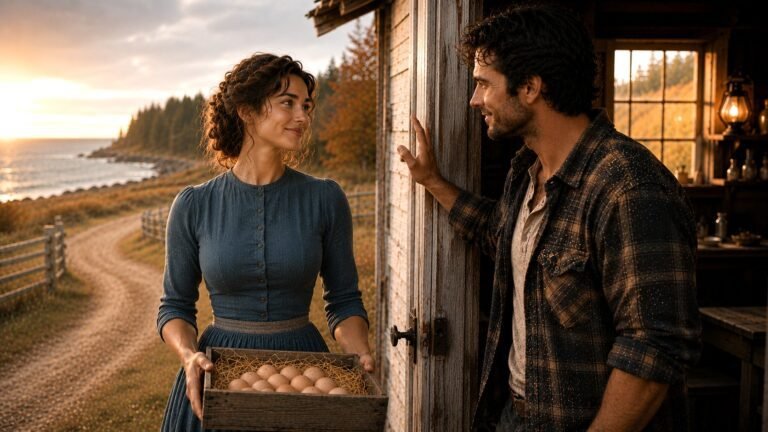


Heartfelt characters sharing love, emotions, and romantic journeys filled with hope, trust, and unforgettable bonds