Search
Close this search box.

The Orchard Kept Its Silence — Until She Knocked
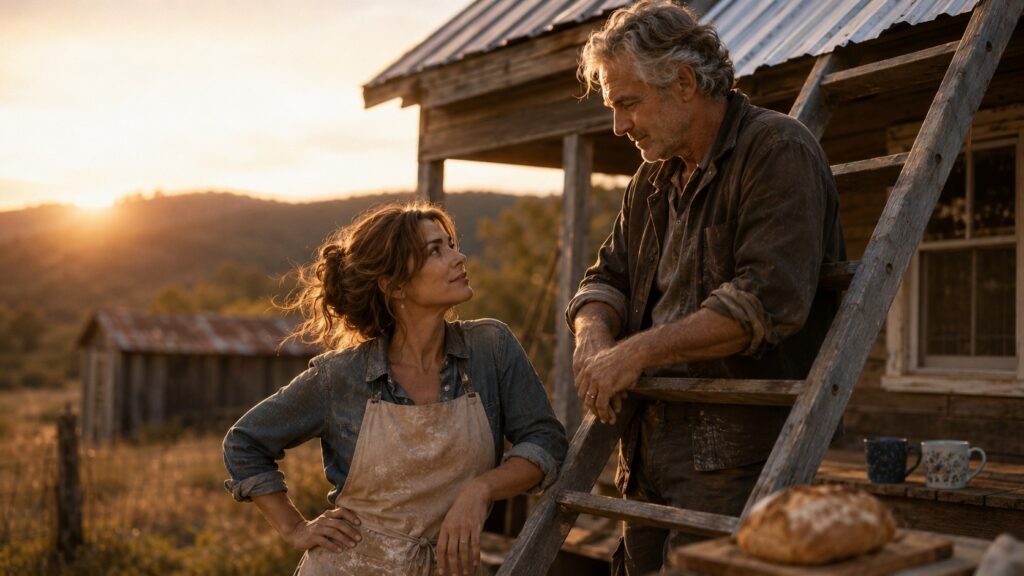
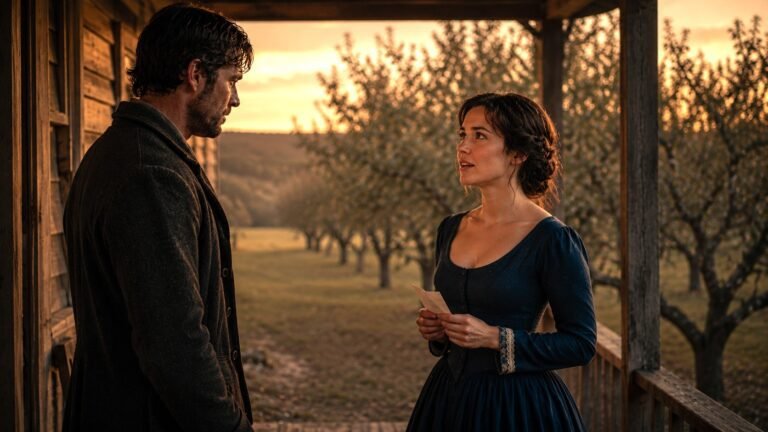
Elias Thorne had told the town of Thistle Hollow, more than once and never gently, that no one was welcome at Marsh Hill Orchard after dark. He did not say this out of cruelty. He said it because a man who has buried the only future he ever planned for learns, eventually, that closed doors hurt less than open ones.

So when the knock came on the night of the last hard frost in March of 1923 — three knocks, spaced evenly, patient in a way that unsettled him more than urgency would have — Elias sat very still at his kitchen table before he rose to answer it.

The wind had been screaming down off the ridge since noon, dragging sleet sideways across the bare apple rows. Elias was thirty-four and had lived alone in that farmhouse for nine years, ever since the fire that took the granary, the toolshed, and Clara Bishop, who was three weeks from becoming his wife when she went back inside for her mother’s quilt and the roof came down before she came out again.

He did not talk about Clara. He talked to almost no one, except Jonah Pratt, who ran the cider press and the hired hands with the quiet competence of a man who valued loyalty over wages, and who had stayed through nine winters because, as he’d put it once, somebody’s got to remember how to laugh around here, even if it isn’t you.

The knock came again. Three, slow, deliberate.

Elias opened the door.

The woman on his porch was soaked to the bone, her wool coat plastered dark against her shoulders, her hat long since abandoned to the wind. She held a scarred leather satchel in one hand and, tucked against her ribs with her other arm, a wooden crate of books — he could see the spines through the slats, a whole life’s worth of well-read paper going soft in the wet.

“My motorcar went into the ditch at the county line,” she said, before he could ask. Her voice did not shake, though her lips had gone the color of skim milk. “I understand there’s no garage open this late, and I understand I’m asking a great deal of a stranger. I only need somewhere dry until the roads are passable. I’ll trouble you as little as I possibly can.”

Elias looked at the crate of books first. That was the detail that undid him, though he would not have been able to explain why — that a woman standing in a Vermont sleet storm with nothing evidently intact in her life except this one wooden box was still holding it like the most important thing in the world.

“Come inside,” he said, and stepped back to let her pass.


Her name was Margaret Doyle — Meg, she told him, though it took three days to earn the shortened version, and he understood by then she did not hand out familiarity easily. She stood dripping by his hearth that first night, still in her wet coat because no one had told her she could take it off, watching the fire with the flat, careful attention of someone who had trained herself not to want things out loud.

He gave her a blanket from the cedar chest. She took it with a small nod and nothing more.

“Where were you headed?” he asked, mostly because the silence had teeth and he wanted something to blunt them.

“Thistle Hollow,” she said. “There’s a teaching position. I’m to start after the term break.” She wrapped both hands around the mug of coffee he set in front of her. “I came up from Boston.”

“Long way for a schoolhouse.”

“Long way from a great many things,” she said, and did not elaborate, and he did not ask.

Outside, the storm worsened. Ice found the windows in hard little volleys. Somewhere under the noise of it, Elias was aware — sharply, uncomfortably aware — of another person breathing in his house. It had been nine years since that was true, and his body seemed to have forgotten how to hold it without flinching.

“There’s a room down the hall,” he said finally. “It’s not been used in some time, but it’s dry.”

She studied him the way a person studies an offer they’ve learned to distrust. “Thank you,” she said. “I mean it. It’s only a room,” he said. “Don’t make it more than that.”

He did not sleep. He sat at the table with the fire burning low and then built back up, and he listened to the ice on the glass, and he thought — against every instinction he had spent nine years cultivating — about the fact that his house sounded different with someone else’s breath in it.


By morning the storm had buried the county road under two feet of drifted snow, and Meg Doyle came out of the spare room already dressed, her satchel packed, prepared, it seemed, to leave on foot if necessary.

“How long?” she asked, looking at the white wall beyond the window.

“Hard to say. A day. Maybe two.” Elias was already at the stove. “Pruitt won’t bring the plow through till the wind lays down, and it hasn’t laid down since Tuesday.”

She set her satchel on a chair — not dramatically, just the practical motion of a person adjusting to a fact she couldn’t argue with. “I’ll earn my keep,” she said. “Tell me what needs doing.”

He had housed stranded travelers twice before in nine years, and both times they had spent the delay complaining, restless, treating the storm like a personal insult. Meg Doyle treated it like weather. She moved into his kitchen without waiting to be asked twice, found the flour and the lard without help, and by the time Jonah Pratt came stamping in from the bunkhouse with frost in his mustache, she was correcting figures in a small notebook at the table like she’d been doing it there for years.

Jonah stopped dead in the doorway. He looked at Elias. Elias gave him a look that said, plainly, don’t.

“Morning,” Meg said, without glancing up.

“Ma’am,” Jonah managed.

“There’s coffee,” she said.

Later, out at the woodpile, Jonah lasted about thirty seconds before he said, low, “Who is she?”

“Traveler. Car went in the ditch. She’s waiting on the roads.”

“She’s sitting in your kitchen.”

“There’s nowhere else to sit, Jonah.”

“You’ve never let a soul sit in that kitchen in nine years.” Jonah pulled his collar up against the wind, something working at the corner of his mouth that was very nearly a smile. “Just weather, is it?”

“Drop it.”

“Dropped,” Jonah said, and was smiling outright when he said it.


The first real conversation happened that afternoon, while the storm held the world in a fist outside the windows and Meg sat with her notebook and Elias mended a bridle at the far end of the table.

“How long have you lived here alone?” she asked, without preamble.

“Nine years.”

“The whole time?”

“No,” he said. “Not the whole time.”

She did not push. She only nodded, the way you nod at a door you understand is closed, and went back to her writing. Five minutes passed before she offered, unprompted, “I had two brothers. Both gone in the war. My father followed them eighteen months later — his heart, the doctor said, though I’ve always thought a man can only carry so much before something in him simply agrees to stop.” She said it the way you set a fact on a table, not for sympathy, just for truth. “I came west — or north, I suppose, from where I started — because there wasn’t a single room left in that house that didn’t hurt to walk through.”

“I’m sorry,” Elias said.

“Thank you.” She looked up, something dry and rueful in her expression. “It’s why I wanted to teach somewhere new. I thought if I could be useful to people who didn’t know what I’d lost, I might remember how to be a person instead of a grief.”

Elias set down the bridle. “That’s not a bad reason.”

“No,” she said, surprised, as if she hadn’t expected him to agree. “I suppose it isn’t.”


She found the photograph on the second morning, not from prying — she’d gone looking for preserves on the pantry shelf, and there beside the jars sat a small tin box with a photograph balanced on its lid. Elias, younger, stood beside a laughing woman in front of the granary that no longer existed, her face caught mid-joy, turned toward something outside the frame.

Meg said nothing about it. But that evening, with the lamp burning low and the wind still working at the walls, she said quietly, “You’re not alone because you prefer it.”

Elias went very still.

“People who prefer solitude are comfortable in it,” she said. “You’re not comfortable. You’re guarding something. Those aren’t the same.”

“You don’t know me,” he said. Not sharp. A warning.

“No,” she agreed. “I don’t.” She held his gaze anyway. “But I know that face. I wore it for the better part of a year after my father died.”

The fire cracked. Neither of them spoke again for a long time.

“You should sleep,” he said eventually.

“Probably,” she said, and closed her notebook, and said his name — goodnight, Elias — as easily as if she’d been saying it for years.

He sat at the table long after she’d gone, staring at nothing, and did not know what to do with the fact that he wanted, very badly, to have said something else.


The roads cleared on the fourth day. Meg came out already dressed, her satchel packed, the blanket folded with a care that told him she’d been raised to leave things better than she found them.

“Jonah can drive you into the Hollow,” Elias said.

“I know. I heard the plow.” She looked around the kitchen once, taking stock. “Thank you for taking in a stranger.”

“It would have been cruel not to.”

“Most people find a reason to be cruel when kindness is inconvenient,” she said, and picked up her bag.

“There’s a teaching post standing empty at the Hollow schoolhouse,” Elias said, before he’d decided to say it. “Has been for two terms. If you’re going to be settling nearby — Ruth Callahan runs the school committee. She’ll want to meet you.”

Meg turned. Something moved behind her eyes. “I already have the position,” she said gently.

“I know. I only meant — the road between here and town isn’t always kind in winter. If you ever needed—” He stopped. He wasn’t entirely sure how the sentence ended.

She watched him struggle with it, and then she smiled — not politely, but warm, the smile of someone who understood exactly what he hadn’t managed to say and found it more than enough.

“I’ll find you if I need anything,” she said, and walked out into the cold, her satchel and her books tucked against her side.

Elias stood at the window and watched the wagon turn out of the gate until the sound of it disappeared into the white distance. Then he looked at the empty kitchen. Her coffee cup was still on the table. He picked it up, washed it, set it back on the shelf, and stood there another full minute with something small and dangerous unfurling in his chest — the first unmistakable sensation, after nine years of careful numbness, of caring again.


He told himself he would not think about her. He was exceptionally poor at keeping that promise.

The first week, he worked the orchard into the ground the way he always did when something was troubling him — up before light, pruning dead wood off the Baldwins until his hands cramped, back inside only when there was nothing left outside to occupy him. Jonah watched all of it with the expression of a man who understood exactly what was happening and had the good sense to say nothing.

The second week, Elias rode into the Hollow for feed and lamp oil and told himself he had no reason to pass the schoolhouse. He did it anyway. The sound found him before the building did — children’s voices, bright and overlapping, the particular chaos of young minds being herded toward attention and mostly succeeding. Through the window he could see Meg at the chalkboard, chalk dust catching the light, the children leaning forward in their seats the way plants lean toward a window.

He did not stop. But he thought about it the whole ride home.

Jonah was waiting at the barn when he returned. “School’s doing well, I hear,” Jonah said, unprompted, entirely too pleased with himself. “Ruth says Miss Doyle’s got every child in that district showing up daily, including the two Kellerman boys, who I don’t believe have set foot in a schoolroom since Coolidge was governor.”

“Jonah.”

“Just passing along news, boss. Which you’d have heard yourself if you’d stayed in town long enough to talk to a living soul.”

Elias unsaddled his horse and said nothing at all, which Jonah correctly read as a great deal.


The third week, Meg came to him, arriving on a borrowed mare with the directness of a woman who hadn’t ridden four miles to pass the time.

“I need a favor,” she said, before he’d fully straightened from the woodpile. “Three of my students live out past Miller’s Crossing — the Whitfield children. Their father’s got a bad hip and one horse for eighty acres, and the thaw’s turning the low road to mud. I want a regular pickup, three mornings a week.”

“Monday, Wednesday, Friday,” Elias said, before she’d finished making her case.

“Why?” she asked, direct as ever.

“Children ought to be in school. And I know that road better than anyone in this valley.”

She reached into her saddlebag and produced a jar of honey and a loaf of bread. “For the trouble of the storm. I was raised to return what I borrow.” Her fingers, cold from the ride, held the exchange one second longer than necessary.

“Monday morning, then,” she said, and rode off, and Elias stood there with bread and honey in his hands like they were something considerably more important.


The Monday run became the shape of the following two months. Elias brought the team out before first light three mornings a week, collected the Whitfield children — Silas, ten and solemn; June, eight, restless as a lit fuse; and little Opal, six, who decided within her first ride that Elias belonged to her personally — and delivered them to the schoolhouse steps, where Meg was always present in the doorway or the yard, always finding five minutes of conversation before the children climbed down.

Five minutes, three mornings a week. It should not have amounted to much. It amounted to nearly everything.

She told him about the children, not as gossip but as a doctor gives a family update: Silas was gifted with numbers but struggled to read the board, and she suspected his eyes rather than his mind. Elias found he was noticing things himself now — that Silas’s boots were splitting at the seam.

He mentioned it to her one Friday, careful not to presume. She went very still.

“I hadn’t noticed,” she said quietly.

“Could’ve started since term began.”

“No. I should have seen it.” She was quiet a moment. “I’ll speak to Ruth about the clothing fund.”

“Or,” Elias said, and then stopped, surprised at himself.

“Or?” she prompted.

“Hollingsworth’s has good leather. I know enough to cobble a repair, if you’d bring me his size.”

She looked at him a long moment, something shifting in her face — not surprise exactly, but the look of a person discovering a room in a house they’d thought they already knew completely.

“Elias.”

“It’s a practical problem,” he said quickly. “I’m offering a practical solution.”

“I know,” she said, and then, softer, “I know you are.”

Silas came to school the following Monday with resoled boots and a baffled expression when Meg told him an anonymous benefactor had seen to it. He spent thirty seconds confused and went back to his arithmetic, because he was ten and practical and the boots fit. Opal, unconvinced by his story of anonymity, informed Elias on the ride home that she knew exactly whose worktable that leather had come from, and allowed him to keep his secret only out of pure generosity.


Meg began coming to the orchard on Tuesday afternoons, her one free day, and the pattern held without either of them naming it. Elias began, without quite admitting it, arranging his week so he was reliably home when she arrived.

He told her about the orchard, his father’s failing years, the frost of 1917 that had cost half the young trees. She listened like it was a skill she’d spent years perfecting. She told him about teaching in Boston before the war took her brothers — forty children in two rooms, under a headmaster who believed girls needed schooling only enough to keep a household ledger, and how she’d spent three years quietly teaching them everything else in the margins.

“You undermined the man,” Elias said.

“I educated children. The undermining was incidental.”

He laughed — surprised himself with it, rough and unpracticed, like something rusted finally turning. Meg went still, watching him with an expression he couldn’t quite place.

“What,” he said.

“Nothing.” She was smiling. “I wasn’t certain you could do that.”

“Laugh.”

“It’s the first time I’ve heard it.”

“I laugh.”

“Not when I’m there to see it,” she said, not unkindly. “Until now.”

He didn’t have an answer for that. That night, alone at the table, he understood the laugh had arrived without his permission — that it had felt, for one unguarded second, like something he remembered from a life he’d thought was sealed shut for good. That was when he understood he was in trouble, and that he no longer entirely minded.


The trouble arrived fully formed on the first genuinely warm afternoon of the year, when the snow had pulled back far enough to make the world feel like a promise again.

Meg came on her usual Tuesday and was quiet longer than usual — the stillness he’d learned meant she was working something through before speaking it.

“Ruth Callahan told me something this morning,” she said finally. “About a woman named Clara.”

The silence that followed was so complete Elias could hear the fire.

“Ruth talks too much,” he said, flat.

“I’m not asking to pry,” Meg said. “I’m asking because I think I’ve been reading you wrong. I thought you’d chosen to be alone. But it wasn’t a choice. It was done to you. And then you built a whole life around the wound instead of around anything you might have chosen for yourself.”

He stared at her. Nobody had ever put it quite that precisely.

“Her name was Clara,” he said, the words strange, like a language he hadn’t spoken in years. “We’d known each other since we were children. We were three weeks from marrying. There was a fire in the granary. She went back in for her mother’s quilt. The roof came down before she came back out.”

“I’m so sorry.”

“It was nine years ago.”

“That isn’t how grief works, and you know it.” She held his gaze. “I’m only saying I know she was real, and I think you’ve spent nine years punishing yourself for surviving her.”

His throat tightened. “You don’t survive a fire because you deserve to more than she did.”

“No,” Meg said gently. “Fires don’t make those decisions. They just happen. Then the living are left making sense of them, or refusing to.”

“How do you know that?”

“Because I nearly didn’t survive my own losing,” she said. “After my father, I stopped answering letters, stopped eating properly, worked until I couldn’t think. And then I understood I was only waiting to disappear. And I decided I didn’t want to. So I came north.”

“Her name was Clara,” Elias said again, testing whether it still cut the same way. It did — but differently now. Like something alive instead of something dead.

Meg reached across the table, not taking his hand, only setting hers near it. “She sounds like she was worth loving,” she said.

When she rose to leave, she paused at the gate. “The wound doesn’t have to be the whole architecture forever. That’s all I’m saying.”

He stood in the gold of the late afternoon and felt, for the first time in nine years, not happiness — not nearly — but the possibility of it. That evening, alone, he said Clara’s name out loud to the empty kitchen, not as a wound this time, but as a goodbye.


March gave way to a hard, contrary spring, the kind that pretended at winter one day and offered something close to hope the next. The orchard woke around him — buds swelling on the Baldwins, the ewes dropping lambs in the lower pasture — and Elias noticed, with something like wonder, that he no longer minded the noise of it.

Meg’s presence had, without either of them agreeing to anything, become a fixture rather than an occasion. Her shawl hung on the hook by his door. Her coffee cup lived on the second shelf. Neither of them acknowledged this out loud, which suited them both.

It was Ruth Callahan who forced the matter into daylight. She drove out to Marsh Hill on a Thursday and said without preamble, “People are talking. About the Tuesdays, about the boots. I’m not here to scold you, Elias. That woman came to this valley with nothing but her wits and her decency, and I will not stand by while her name gets dragged through gossip because a man can’t make up his mind.” She fixed him with a look that had humbled sturdier men. “Either you’re serious, or you put some distance between yourself and her before the distance gets chosen for you.”

She left him standing at the fence with those words lodged under his ribs. That night he turned them over the way he turned a stubborn ledger, until the answer arrived without fanfare — flat, quiet certainty, like solid ground found after a long time on uncertain footing. He was serious. The question was whether he had the courage to be serious out loud.


The news that changed everything came on a Friday morning, riding hard on a lathered horse.

Tom Kellerman pulled into the yard, face tight. “There’s trouble at the millpond crossing. The Delaneys’ wagon went through where the ice broke up early — mother, father, three children. Two can’t walk. The little one’s not answering.”

Elias was moving before the sentence finished. “Get Doc Ambrose. Tell Ruth to open the church hall for blankets. I’ll have them at the schoolhouse within two hours.”

He rode north hard through mud and standing meltwater and found the Delaneys strung along the bank, their wagon half-swallowed by black water, the horses gone, all five soaked and shaking hard enough that two of the children had bitten their own lips bloody. The youngest, a girl no older than four, lay unmoving in her mother’s arms.

He wrapped her in his own coat, organized the rest with the same methodical calm he brought to a bad calving season, and set the father — arm broken, still clear-headed — on horseback with the two older boys, pointed south toward Marsh Hill and Jonah.

He carried the girl himself, two miles on foot, talking to her the whole way — not certain she could hear him, but silence, in that moment, felt like giving up, and Elias had never learned how to do that. “You’re all right,” he told her. “I’ve got you. Nobody’s letting go.”

He met Meg on the road, riding hard with blankets across her saddle. She took in the scene in two seconds — the child, his missing coat, the exhaustion he hadn’t let himself feel — and was off the horse before it fully stopped.

“How long’s she been like this?”

“Near forty minutes. Her breathing’s steadied some.”

Meg pressed a hand to the girl’s face. “She’s cold, but she’s coming around — look.” The child’s eyelids fluttered.

Elias exhaled — the first full breath since he’d lifted her from the bank.

“Doc’s behind me,” Meg said. “Tom found me first. I told him you’d bring them south. I knew you’d be on foot, if you had a child in your arms.”

“How did you know that?”

“Because I know you,” she said simply, and there was no room in the middle of a crisis to sit with what that meant — but he did anyway, briefly, the way a man touches something warm when the rest of the world has gone to ice.


The Delaneys stayed at Marsh Hill four days while the roads dried. The little girl — Ivy — ran a fever for two nights, watched over in shifts by her mother and by Meg, who arrived each morning and stayed until dark.

On the second night, Elias found her still awake at midnight, reading by lamplight beside the child’s bed.

“You should sleep,” he said.

“Soon.” She closed the book. “You didn’t have to do any of this.”

“It’s my land.”

“It’s your kindness. The land’s incidental.” She looked up. “You rode out not knowing what you’d find.”

“Tom said you rode out before you knew either.”

“I came because I didn’t want you out there alone. That’s all.”

“Meg,” he started.

“Don’t,” she said gently. “Not something you’re not ready to say. There’s no hurry.”

“I’d like to be ready,” he said, the words unplanned but certain.

She went very still, then crossed the small room and stopped two feet from him. “I’ve been hoping you’d say something like that for about six weeks,” she said. “I’m a patient woman. I am not an infinitely patient one.”

Something broke open in his chest — not painfully, the way river ice breaks from beneath when the water underneath has finally warmed enough to demand it.

“When this is settled,” he said. “When the Delaneys are home and things have quieted—”

“I know,” she said. “I’ll be here.”

“Tuesday,” he said.

She smiled. “Tuesday.”


The Delaneys went home eight miles east, and word of the rescue traveled through Thistle Hollow fast and embellished, as it always did. Elias found he no longer minded being spoken of.

On the porch, four days later, he told her the rest of it — the fear underneath the reluctance.

“I’ve been afraid,” he said. “Not of you. Of wanting something again and having to learn how to lose it a second time.”

“That’s an honest thing to say.”

“I’m working on honesty. You’ve been a considerable influence.”

“I don’t know how to do this slowly,” he admitted. “I don’t know if I have the patience left to be careful. I’ve been alone too long, and I’ve gotten particular, and I’m not always—”

“I teach fifteen children,” Meg said, “three of whom are Kellermans. I have a considerable tolerance for difficult.”

“I’m serious,” he said.

“So am I.” Her voice was warm, steady, certain. “I didn’t ride out to that millpond because it was convenient, Elias. And I didn’t come to your kitchen for two months of Tuesdays because I had nowhere better to be.”

He took her hand — not dramatically, just the way a person takes hold of something they’ve decided belongs in their grip. Her fingers, cold as always in the early hours, closed around his.

“I’d like to court you properly,” he said. “If that’s acceptable.”

“It’s more than acceptable,” she said, and squeezed his hand once, and that, as far as either of them was concerned, was that.


What neither of them yet understood was that the hardest test had not arrived. It came three weeks later, in the person of a timber speculator named Corwin Vance, who rode into Thistle Hollow with two men and the confidence of someone who considers himself clever and has come to collect.

Friday morning, Mayor Alden Fitch arrived at Marsh Hill, hat in both hands, with news he clearly couldn’t soften. “Elias, there’s a man in town — Vance. He’s got papers, filed and registered, claiming the north forty under a timber reservation clause from ’96. Says your father’s original grant never satisfied the improvement condition.”

“That land’s been ours since 1889. I have the deed.”

“I know. But he’s got a Burlington lawyer, and I don’t have the standing to sort out whose paper trumps whose. This is past what the town can settle.”

Elias stared at him a long moment. “Get off my property,” he said — not in anger, but with the flat calm of a man saving his fury for where it would do the most good.

The north ridge was the best hardwood stand on the property, the timber that fed the cider press through every hard winter and paid for seed in lean springs. Losing it wouldn’t break the orchard outright, but it would starve it slowly — and slow starvation meant letting hands go, meant Jonah Pratt, after eleven years, having to find his living somewhere else.

Elias was not going to let that happen.


Meg came within the hour, having heard in town, which in Thistle Hollow meant within about forty minutes of the mayor’s buggy leaving Marsh Hill.

“Tell me everything you have,” she said, sitting across from him at the table already covered in deed boxes.

He told her. She listened without interrupting — one of her particular gifts, receiving information fully before responding to it — and when he’d finished, she was quiet a moment.

“The improvement clause he’s citing — what’s the exact statute language?”

“I don’t know it precisely.”

“Then we find it,” she said. “Because the statute’s the weapon, and if it doesn’t say what his lawyer claims it says, the whole claim collapses. Is there anyone in Montpelier who could get you the original registry file?”

There was — a clerk named Osgood whose nephew Elias had once pulled, alive, from a flooded quarry. He wrote that night. Meg helped him draft the letter, insisting he ask not for interpretation but for the raw original file.

“If Vance’s lawyer’s building his case on a document you haven’t seen,” she said, “you need the original, not somebody’s reading of it.”

Elias looked at her. “That’s exactly right.”

“I know,” she said, without a trace of false modesty.


Vance did not wait for letters. He came to Marsh Hill himself two days later, alone — which Elias found telling. A man confident in his claim came with lawyers. A man alone had come to make an offer.

“I’m not an unreasonable man,” Vance said, pleasant in the practiced way of someone used to getting what he wanted. “I’m prepared to offer you a settlement for the north forty — assessed value plus twenty percent.”

“You’re offering to buy land that’s already mine.”

“I’m resolving an ambiguity.”

“There’s no ambiguity. There’s your claim, and there’s my deed.”

Something thinned at the edges of Vance’s expression. “Proceedings take time, Mr. Thorne, and the parcel in dispute typically sits under administrative hold while they run. Could be a year. Two summers without that timber stand would be significant.” He let the arithmetic land, then added, quieter, “I understand you’ve grown close to the schoolteacher. It would be unfortunate if her position here were complicated by association with a contested legal matter. Small towns remember these things.”

Elias did not answer. He watched Vance ride out and stood very still afterward — not with hot rage, but something colder and clearer. Vance wasn’t only after timber. He was after leverage, and he’d correctly identified the one thing Elias would do nearly anything to protect. Which meant Meg was in this now, whether she knew it or not.


He almost didn’t tell her — handle it alone, don’t drag anyone into your trouble — before Meg dismantled that instinct without knowing she was doing it, arriving Sunday and finding him at the table with the stillness of a man managing something internal.

“What else happened?” she asked. He told her, unsoftened.

“He thinks you’ll fold to protect me,” she said finally.

“Yes. And I was considering it. For about a day.”

“Don’t,” she said, firmer now. “I am not something to be managed at a safe distance so I don’t get damaged. I came to Vermont alone with a satchel and a box of books. Corwin Vance does not frighten me.”

“It should concern you.”

“It does. There’s a difference between something that concerns me and something that makes me want you to fight less.” She held his gaze. “Fight hard. I’ll manage whatever comes at me.”

“You are the most—” he started.

“I know,” she said, smiling, sudden and fierce. “It’s why you like me.”

Something in his chest broke loose, warm and involuntary. “Yes,” he said. “It is.”


The Osgood letter arrived nine days later, eleven pages, and Elias read it twice before he breathed properly for the first time in a week. Meg arrived within the hour, having left a lesson mid-sentence.

She read it in silence, her expression moving through concentration, then something sharp and satisfied. “The clause he’s citing wasn’t added to statute until 1904. Your father’s grant was 1889 — it can’t apply retroactively, and Osgood’s registry shows no extension was ever filed under it, because the clause didn’t exist yet.”

“His lawyer knows this.”

“His lawyer is betting you don’t.” She set the letter down. “We need to correct that bet. Publicly.”

The plan she built anticipated the counterargument before it arrived. It involved Ruth Callahan, whose opinion carried the weight of small government, and a town meeting at the Grange hall, every lamp lit, every chair filled, Vance seated in the second row beside his lawyer with the growing expression of a man beginning to understand he’d misjudged his opponent.

Elias did not speak. Meg did — standing at the front with the Osgood letter and a calm, exact voice, walking the room through what the claim asserted, what the statute actually said, and what the gap between the two meant for every family holding land under a pre-1904 grant, which was most of them. By the time she finished, the temperature of the room had shifted entirely. Vance’s lawyer attempted a response and was met with a silence louder than argument.

The meeting ended without formal resolution but with something more durable: every farmer there walked home understanding this would not be Elias Thorne fighting alone.


Outside afterward, Ruth Callahan found them by the door. “Miss Doyle, I owe you an apology. I told Elias he ought to settle his mind about you before your reputation suffered. I implied you were something needing protecting.”

“You were wrong,” Meg said, gently, before Ruth could finish apologizing properly.

“I was,” Ruth admitted. “You’re something this valley needed.”

She went for her buggy. Jonah went for the horses. Elias and Meg stood alone in the cold, lamplight spilling gold from the Grange windows.

“You didn’t have to do that,” he said.

“Neither did you,” she said, and he touched her cheek, brief and careful, and she leaned into it the way a person leans toward warmth without deciding to.


Vance left Thistle Hollow ten days later. The county registrar had submitted his own report to Montpelier after the town meeting, and the claim quietly collapsed under it. The north ridge stayed exactly where it had always been — his father’s land, his.

The morning Jonah confirmed Vance’s men had gone, Elias walked out to the ridge and stood a long while among the hardwoods, feeling the solid, ordinary fact of ground that was his. He thought of his father, of what it meant not merely to hold something but to choose it, every day, against everything trying to take it. Then he thought of Meg, and walked down to the house, where she was on the porch, coffee in both hands, hair still down.

“I want you to stay,” he said plainly. “Not just Tuesdays. I want to build something here, with you.”

She looked up, eyes bright. “I’ve been thinking about direction too. When I left Boston with my bag and my books, I think this was always where I was headed. I just didn’t know it yet.”

He took the cup from her hands and set it on the rail, and took her hands instead — cold, as always in the mornings — and it was nothing like the drowning he’d spent nine years afraid of. It was the opposite. The feeling of finding the surface after a long time under.

“I’d like to ask you something properly,” he said, “when the time is right, if you’ll let me.”

“I’ll let you,” she said, steady and a little unsteady all at once.


The time arrived faster than he expected, because he’d stopped arguing himself out of what he wanted. It was Opal Whitfield who forced it into the open, the way only a six-year-old with total conviction can.

“Are you going to marry Miss Doyle?” she asked one Monday morning, wedged against his arm in the wagon.

Elias’s hands tightened on the reins. “That’s a private matter, Opal.”

“Mrs. Callahan says you are,” Opal said, serene, citing her source like scripture. “She told my mama the whole valley was waiting on you.”

June, having considered the matter fully, delivered her verdict. “I think you should marry her. She teaches us poems. Somebody ought to be nice to her for it.”

Elias kept his eyes on the road, something shifting hard in his chest. He dropped the children at the schoolhouse, where Meg looked at him with the expression Opal had rightly identified as different from her school face.

“I’ll come by this evening,” he said.

“All right,” she said, something changing in her own face too.

He spent the afternoon at his father’s old writing desk, a thing he hadn’t done in years, and after considerable effort wrote exactly three words on a scrap of paper, folded it, and put on the good jacket he hadn’t worn since Clara’s funeral.

He rode into town. Meg was on the Callahans’ porch, wearing not her school dress but the deep blue one that had been her mother’s. She had known he was coming.

“You wore your good jacket,” she said.

“You’re in your good dress.”

“I didn’t want to be underdressed for whatever this is.”

He held out the folded paper. She unfolded it, read the three words — Stay with me — and looked up with bright eyes.

“That’s what you want,” she said. Not a question.

“Everything that comes with it.”

“I came to Vermont with nothing,” she said. “A bag, some books, an address in Thistle Hollow. That was my entire plan. And then you opened your door in a March storm and looked at my books before you looked at anything else about me. I thought — here is a man who notices the right things.”

They stood together on the porch in the fading light, and neither of them needed to say anything more, because that had said everything worth saying for the whole of the life ahead of them.


The wedding happened the way things happen in small towns — all at once, with tremendous enthusiasm. Ruth organized it in four weeks and made it look effortless, which fooled no one. Jonah wore a suit that had clearly not seen daylight since before the war. The Whitfield children came, Silas standing very straight in his resoled boots, Opal performing flower girl with the conviction of someone collecting her due after personally orchestrating the entire courtship.

On the morning of it, Jonah tied Elias’s cravat because his hands weren’t quite steady, and both men pretended not to notice.

“Clara would have liked her,” Jonah said, without preamble.

Elias went still. “Yes.”

“Don’t thank me,” Jonah added, before he could. “Just don’t stand in your own way anymore.”

“I won’t,” Elias said, and meant it in a way he never had before.


Years assembled themselves the way years do — faster than anyone expects, gentler than anyone deserves. Marsh Hill grew: a new stand of Baldwins on the reclaimed north ridge, a cider operation Elias built with a satisfaction he never once tired of, and, in time, two children — James, the second year, and Ruth, two years after, named for the debt Meg wanted honored, which Ruth Callahan denied fiercely having earned even as she cried over it.

The Whitfield children grew too. Silas got his spectacles at twelve and stood very still the first time he wore them, saying, in a voice trying hard to sound older than it was, “Everything’s got edges now.” He became a surveyor. Ivy Delaney grew up to study medicine, which surprised no one who remembered a four-year-old barely breathing in Elias Thorne’s back bedroom while Meg kept the lamp burning through the night.

Jonah stayed. He had always been going to.


On the tenth anniversary of the March storm, Elias and Meg sat on the porch in the evening — the same porch where she had once answered stay with me with one word. The children’s noise drifted from inside, James’s laugh loud and unguarded, then quiet again.

“Ten years,” Meg said, leaning into his shoulder.

“Ten years.” His arm around her had long since stopped feeling like a choice and started feeling like something structural.

“Tell me what you were thinking. When I knocked.”

“You always ask that.”

“You always give a different answer.”

He was quiet a moment, the night settling around them, warm and full of early stars.

“I was thinking you were a complication,” he said. “I was thinking about your books — why you were protecting them like that, in the middle of losing everything else. And then I thought, here’s a person still thinking about what she came here to do, even now. I couldn’t send someone like that back into the cold.”

Meg was quiet, then said, “I was so tired that night. Not just from the road. From being alone, from being afraid, and from not being able to stop.” She looked up at him. “And then you opened the door and looked at my books before anything else, and said come inside, and didn’t make it into anything at all. You just made room.”

He held her. She let herself be held. Somewhere above the ridge, the stars burned steady and indifferent and beautiful over a house that no longer stood as a monument to what had been lost, but as proof of what two people, wounded separately, had chosen to build together instead.

For years afterward, people in Thistle Hollow told the story — not as tragedy redeemed, not even quite as romance, but as something plainer and more lasting: the story of a man who answered a knock in a March storm, and a woman who knocked on the right door. And when people asked Elias, in later years, how he’d changed so completely, he always gave the same answer.

“Someone knocked,” he’d say. “And I opened the door.”

That was the whole of it. That was enough. That was everything.

She Said, “Fresh Eggs—Twelve Cents a Dozen”… He Joked, “I’ll Take Two If You Stay for Breakfast.”

Thornhollow Cove, Maine, 1946

Clara Whitfield left the house before the gulls did, which in October meant walking down to the henhouse in a dark so complete it had a weight to it, a wool coat over her nightclothes and a lantern swinging cold light across the frost-stiffened grass. It had been her life for three years now, since her father’s dory went down in a squall off Widow’s Point and left her a flock of forty hens, a smokehouse, eleven acres running down to the tide flats, and a debt she had never once spoken about outside the walls of her own kitchen.

She did not know it yet, but the hurricane of ’38 was the reason any of it had happened at all. It had come through eight years earlier and torn the coast to pieces — boats splintered on the rocks, weirs gone, whole families with nothing left to fish from or farm with. The ones who survived it with anything standing knew exactly who had come around afterward with cash money and a patient smile, buying up ruined land for a fraction of what it had been worth the week before.

One of those men was Elias Vane.

Clara carried her eggs in wooden flats she padded herself with straw, packed into the bed of a hand cart she pulled along the shore road because the family never had money enough to keep a truck running. To keep the eggs cool through the warm months she stored them in the springhouse dug into the hill behind the barn, the one built by her grandfather, stone-walled, spring-fed, the only icebox a family like hers could afford.

That was how it was done in Thornhollow Cove, and it worked well enough. The route took two hours on a good morning, eleven houses, starting at the Pruitt place at the top of the ridge road. The list had changed the month before. The old Ashford cottage, empty for four years since Peter Ashford disappeared rather than stand trial for a theft everyone in the cove still argued about over supper, had a new light in its window.

Six weeks earlier, a man had come down from Bangor on the mail boat and started putting the place back together board by board. Nobody in town could say for certain who he was, only that he worked from can’t-see to can’t-see and kept to himself, and that once, when old Mrs. Pruitt asked him straight out, he’d said only that his name was Ashford too.

Clara knocked twice on the cottage door on the second Thursday of October. No one answered either time. She knocked again the following week, and this time the door swung open on a man with sea-dark hair gone unruly, sawdust on the shoulders of his flannel, and the look of someone who had been awake working since before the light came up.

“Fresh eggs,” she said, holding up the flat between them like a shield. “Twelve cents a dozen.”

He looked at the eggs. He looked at her.

“I’ll take two dozen,” he said, “if you’ll stay long enough for breakfast.”

She looked at the sawdust on his shirt, the coffee pot she could hear ticking on the stove behind him, the cold gray morning at her back and the two hours of route already behind her, and nowhere in particular she had to be for the next hour of her life.

“I’ve got the stove hot already,” he said, “and biscuits that just came out.”

She went in. It was not ten minutes before she’d forgotten to be careful about it.

The Ashford cottage was not what she expected. The front room still smelled faintly of the smoke damage from the year it had stood empty, but someone had scrubbed the hearthstones white and hung the cookware in neat rows by size, and a window over the washbasin faced the water so the whole kitchen filled up gold when the sun cleared the point. He moved through that small space like a man who’d built it with his own hands, which, she would learn, he very nearly had.

He split the biscuits without ceremony, laid the bacon without fuss, poured her coffee before he’d asked how she took it, and when she reached for the sugar tin, it was already sitting by her elbow, which told her he had planned for her to stay before she’d agreed to.

“You’re Peter’s brother,” she said.

“I am. Samuel.” He set the pot back on the stove. “Samuel Ashford.”

“Clara Whitfield. My family keeps the henhouse and the smoke shed at the south end of the cove road.”

“I know. I’ve seen your cart on the ridge three mornings running.” He sat across from her. “I’ve been six weeks learning how this town works. Who talks to who, who owes who. Easier to understand a place before you try to live in it again.”

She ate the biscuit, which was good, and the bacon, which was better, and drank coffee that was the best she’d had since her father used to make it too strong on Sunday mornings before church. She didn’t say any of that aloud. She said, “What happened to Peter?”

His face went still the way a door goes still when someone’s holding it, deciding which way it means to swing. “He was accused of hauling traps that weren’t his off the Hollis grounds, four years back,” he said. “He didn’t do it.”

“How do you know?”

“Because I know my brother. And because those traps turned up the next spring re-branded and sold off a stretch of shoreline that got bought up not long after by a man who had every reason to want Peter gone and discredited.”

“What man?”

“Elias Vane.”

Clara went quiet in a way that made him look at her twice.

“I know that name,” she said.

She did not tell him everything that morning. She told him the surface of it — that Vane ran the cannery and the general store and had a hand in half the cove’s business, that his name had a way of turning up in every transaction nobody could quite explain to your satisfaction. She did not tell him about the note her father had signed, or who held it now. That was her own trouble, and she had been carrying it alone for three years, the way you carry a weight so long you forget it has a shape other than your own back.

She left the cottage forty minutes after she’d arrived, later than she meant to and not sorry for it.

“Same time next Thursday?” Samuel asked at the door.

She looked at the flat in her hand, two dozen eggs lighter. “You only took two dozen.”

“I’ll need more by Thursday,” he said. “Seems I’ve taken up baking.”

On the walk back down to the cart, she thought about Vane, about Peter Ashford, about traps that weren’t his and a man well connected enough that nobody in the cove had ever thought to ask a hard question out loud. She thought about her own father’s note and who held it, a question she had been putting off for the better part of a year, because some answers, once you have them, cannot be unknown again.

She decided that week she was going to find out.


Thursday she came with three dozen. He’d laid out a real breakfast this time — fried potatoes, eggs done soft the way she hadn’t mentioned but he’d guessed, bread still warm enough to steam when she tore it.

“You planned for this,” she said.

“I knew you were coming.” He set the plate in front of her. “Seemed sensible to be ready.”

“This is not a man who needs three dozen eggs a week.”

“I’ve taken up baking,” he said again, and left it there, which made her laugh before she could stop herself, a short surprised sound that seemed to please him more than anything he’d said all morning.

She looked at him a long moment over the steam off her coffee. “Samuel. Why’d you come back here, of all the places you could’ve gone?”

He thought about it — not the quick answer, the true one, the way a man does when he’s decided a question deserves the extra silence. “Because Peter is somewhere out there in the world still carrying what was done to him, and whatever was done was done here. The only way I know to fix it is to be where it happened and understand it well enough to undo it.” He turned his cup a quarter turn on the table. “And because the land’s ours. Was ours before Vane ever got a foothold on this coast, and I’m not going to let that be the end of the story.”

“That’s two reasons.”

“It is. There’s a third, but it’s not fully formed yet.”

She almost asked. She saw him see her almost ask, and something in his face made her look at her plate instead.

They talked an hour past when she should have been back on her route. When she finally stood to go, he walked her out to the cart.

“Saturday?” he said.

“I don’t run deliveries Saturdays.”

“I know,” he said. “I wasn’t asking about the eggs.”

She pulled the cart the rest of the way home turning that sentence over the whole time, the plainness of it, like he’d handed her something and expected her to already know what it was for. She told her mother she’d be out Saturday morning. Her mother, who had watched her daughter leave before light for three years without once complaining, said only, “Wear the blue dress. Not the work one.”

Clara wore the blue dress.

Samuel took her walking along the tide flats that Saturday, the water gone out so far it left the mudflats bare and glistening under a low gray sky, gulls working the shallows for whatever the tide had left behind. He’d brought a pail of steamed clams wrapped in cloth to keep the heat in, and they sat on an overturned dory hull above the wrack line and ate them with their fingers, salt and butter and woodsmoke on the wind.

“You don’t talk about the war,” she said, watching him work a clam shell open with a thumbnail.

“No.” He set the empty shell in a small growing pile between them. “There’s not much of it that improves in the telling.”

“You don’t have to tell it.”

“I know.” He looked out at the water a moment, at some point past the horizon she couldn’t follow him to. “Peter used to say I came back quieter than I left. I think that’s true. There’s a kind of quiet that settles into a man out there and doesn’t leave when the fighting’s done. You just learn to carry it different.” He glanced at her. “You’d know something about carrying things different. You’ve been doing it three years.”

“That’s not the same as war.”

“No,” he agreed. “But grief doesn’t much care what shape it takes getting into a person. Your father, my brother — different griefs, same weight, near enough.” He handed her another clam, still warm. “I noticed you don’t talk about him either. Your father.”

“Not much to say that isn’t just missing him.”

“That’s plenty,” he said. “That’s the whole of it, most days.”

They sat a long while after that without either one of them saying much of anything, the tide beginning its slow crawl back in around the dory hull, and Clara found she did not mind the silence at all — found, in fact, that she had not felt this unhurried in longer than she could easily count.

“I should get back,” she said eventually, though she made no move to stand.

“Should,” he agreed, and neither of them moved for another quarter hour.


She confirmed it on a Monday at the county registry office in Ellsworth, a forty-minute wagon ride she made up an excuse to take. The original note on the Whitfield land had been held by Merchant’s Trust in Bangor. It had been quietly transferred, fourteen months back, into the private holding of one Elias Vane.

But there was something else in the file, something the clerk had no particular reason to point out to her and that she very nearly missed on her way past it. Buried in the original loan papers from 1938 — the year of the storm, the year everything in the cove had gone sideways at once — was a co-signer’s clause. The name on it, ink gone brown with age, was the same one.

Elias Vane.

It meant Vane had known about her family’s debt, and the value of their shorefront acreage, since before the storm ever hit. It meant he had held a financial interest in the Whitfield land he had never once disclosed to the family whose note he later bought and whose farm he was, patiently, quietly, buying out from under them. Under Maine law, a co-signer who purchased a note without disclosing that conflict to the original borrower wasn’t operating in some gray, defensible corner of the law. It was fraud, plain and documented, sitting right there in his own signature gone faint with time.

Clara stood at the counter a long while. She walked out onto the street and did the arithmetic in her head the whole way to the wagon. The interest on a transferred note ran different from what the bank itself would have charged. The payment she’d been counting on making in the spring wouldn’t cover it. Ten months, if the hens laid well and the winter wasn’t cruel.

She thought about the spring that fed her family’s springhouse, cold and constant for sixty years, and how under Maine water law the rights to it were worth more than the eleven acres sitting above it, because whoever held those rights controlled everything that depended on that water downhill.

She thought about Vane’s cannery, less than a mile down the shore from that spring, always short of clean fresh water in the smoking sheds.

She understood.

She didn’t tell Samuel. Not yet. It was her trouble, and she’d been carrying it alone long enough that the carrying itself had started to feel like the only proof she had that she could.


Before the story goes on, I want to ask you something. If this one’s keeping you company tonight, tell me in the comments what you’re doing while you listen. I read every one.

Now, back to the cove — because Samuel Ashford had been doing some digging of his own.

He’d been at it for weeks, not out of some vague hunch but the way a man works a problem when he means to actually solve it: back to the beginning, and through it in order. The beginning was the Hollis grounds, the autumn of 1937. Twelve strings of traps gone missing, turned up the following spring off a stretch of shore two coves over, one that got folded into Vane’s holdings not long after, sold for well under what any waterman would have called it worth. The fellow who’d owned it left the county inside a month, and no one ever got a straight answer why.

The buoys on the recovered traps carried the Ashford colors, repainted — a second color worked in over the first in a way that took real knowledge of the original scheme to disguise properly. The man who’d reported the theft to the county sheriff hadn’t been Hollis at all. It had been Vane, who ran no traps of his own on that stretch of water and had no obvious business noticing whose gear sat where. He’d simply mentioned, in passing, seeing Ashford buoys where they had no cause to be.

The sheriff’s original inquiry had been thin — no warrant, no depositions, the whole matter closed the hour Peter left town rather than face a charge with nothing standing between him and it.

Samuel spent three weeks writing letters to anyone who’d fished those waters in ’37. Two wrote back. One, a widow in her seventies who still kept a skiff tied at her own dock, remembered seeing Peter the night before the traps went missing — miles up the coast, helping four other men re-float a grounded schooner off Corbett’s Ledge, men who could all still vouch for where he’d been. None of that had ever made it into the sheriff’s file.

Samuel knew it wasn’t enough on its own to reopen anything. He’d need the state to agree to a formal review, with authority to examine the county’s buoy and sale records, and that would take weeks he wasn’t sure he had. He wrote to the Attorney General’s office in Augusta requesting exactly that, and attached his witnesses’ names.

The answer came back in early November. A state investigator would come down to Thornhollow Cove in person, with authority to examine the records and take depositions under oath.

That was the same week Samuel went to the registry office himself — the same Monday Clara had gone, neither of them yet knowing the other had stood at that same counter.

He told her on a Saturday what he’d found about the debt and the spring, because it was her situation and she had a right to the shape of it, even the part of the shape that touched him.

She listened without interrupting. “I already knew,” she said when he finished. “Found it out myself, weeks ago.”

“And you didn’t say.”

“It’s my trouble. I was handling it.”

“You’ve been handling it alone three years,” he said. “That’s not the same as it not being anyone else’s business to help with.”

“I don’t want charity.”

“It isn’t charity.” He said it plainly, the way he said most things. “I’ve got a cousin who runs the fish house in Bar Harbor who’d buy eggs and cured hams straight off you if you could put up more than the cove can eat — that’s a market, not a favor. I’ve got a smokehouse standing empty on my own land I’ve no earthly use for by myself. In return, you tell me everything you know about Vane’s dealings in this cove, because I mean to put a stop to them.”

She considered it the way she considered everything — practically, turning it over for the sense in it the way she’d once rebuilt her own cart wheel with scavenged spokes rather than pay a wheelwright. The offer made the kind of sense the things worth doing usually make.

“All right,” she said.


Vane heard about the state’s inquiry sooner than anyone expected. A clerk in Ellsworth owed him favors going back a decade. He did not back off it. Vane had come through the storm of ’38 by buying land off desperate people at a fair remove from the law, and he was not the sort to fold over one old witness and a stack of yellowed paper.

He started a rumor instead — that Samuel Ashford’s interest in the Whitfield place ran deeper than eggs, and that the interest had a name: the spring. And he did more than talk.

One night in the second week of November, two men working for Vane came out along the Whitfield property line where it ran down toward the springhouse. They had not come to burn anything or steal anything. They had come to survey. They drove iron stakes along the bank of the stream that fed the springhouse, close enough to the water that the meaning wasn’t lost on anybody who found them. One of the men, on his way back out, put a boot through a section of the hen-yard fence, and eleven birds got loose onto the shore road before morning.

Not an accident. A message.

Clara found the stakes at first light, out looking for the missing hens in a cold that put a burn in her chest with every breath. She stood over the iron a long time before she pulled each one out of the ground with her bare hands, the metal so cold it took the skin off her palms in thin red lines she didn’t feel until later.

She didn’t tell her mother. She told Samuel, and this time she didn’t hesitate over it.

He turned the stakes over on his own kitchen table, reading the maker’s stamp burned into each one. “That’s not a rumor,” he said. “That’s intimidation. And intimidation leaves a trail a rumor never does.”

He brought the stakes to the state investigator, who was still in the cove finishing depositions on Peter’s case. The man examined the stamp, matched it to the lumber mill that supplied Vane’s own cannery sheds, and added it without a word to what he was already building.

Even so, for two weeks after, Clara stopped delivering to the Ashford cottage. She left the eggs at the gatepost and kept walking. She told herself it was caution — that she couldn’t afford to be seen tied too close to a land dispute with Vane watching every cart on the ridge road. It was easier to tell herself that than to admit what she was actually afraid of, which wasn’t Samuel at all, but what it would cost her to let herself get closer to someone and then lose him and the spring both to the same man in the same season.

He left her payment tucked under a stone at the gate every time and never once came looking for her to ask why.

On the fifteenth morning, he was waiting at the gate when she came up the road.

“I know you heard the talk,” he said. “And I know the stakes frightened you plenty. I want to say one thing, and then I’ll let you go on with your route, and whatever you decide after that is yours to decide, not mine.”

She held her ground and let him say it.

“I found that spring in the county records two weeks before I ever learned about your father’s note,” he said. “Found the note after. Understood what Vane meant to do with the both of them after that. I did not come to your gate because of water rights, Clara. I came because the same man who ruined my brother’s name is working to ruin yours, and staying quiet about that wasn’t a thing I was built to do.”

She stood there with the cart handle biting into her cold hands. “The spring’s mine,” she said finally, testing it.

“It’ll stay yours,” he said. “I’ve no interest in your eleven acres or your water right or anything at all on the Whitfield place except the woman who hauls eggs up this ridge before the sun’s over the water and mends her own fences and won’t take a thing from a man unless the trade’s fair on both sides.”

She was quiet a moment, the wind coming up cold off the cove behind her.

“I owe you an apology,” she said. “I knew you well enough by then to know better. I took the easier answer for two weeks running.”

“The easier answer’s the one that lets you not look straight at a thing,” he said. “You look at everything straight on. It’s one of the — ” He stopped himself before the sentence finished, like he’d heard how far it was about to go.

“Come in for breakfast,” she said instead of asking him to finish it.

“I’m off my own route today,” he said, and opened the gate for her before she’d even set the cart handle down.

Inside, he put the coffee on without asking and she found herself watching his hands the way she hadn’t quite let herself before — the deliberate, unhurried way he did every small thing, like the doing of it mattered as much as the thing done.

“I nearly didn’t come today,” she admitted, turning her cup slowly on the table. “I stood at my own gate a full ten minutes deciding.”

“What decided you?”

“My mother, if you want the truth of it. She said I was wearing a groove into the kitchen floor with all my pacing and either I should go up the ridge or stop pretending I wasn’t thinking about going.” Clara looked at her hands. “She’s not wrong about much, my mother.”

“I’d like to meet her properly. Not just waving from the road.”

“She’d like that. She’s been asking after the man who bakes bread twice a week for a girl who only asked for eggs money.” Clara allowed herself a small smile. “Word travels fast on the ridge road.”

“Word travels fast everywhere there’s fewer than a hundred people in it,” he said. “I grew up here, remember. I know exactly how fast.”

“Then you know what it’ll do with this. Two weeks of me leaving eggs at your gatepost and not coming in — half the cove probably has us married and divorced twice over by now.”

“Let them talk,” Samuel said, and there was nothing careless in the way he said it, only a kind of settled certainty that made her look up at him. “I’ve got nothing to be ashamed of in how I’ve gone about this, and neither do you. A woman being careful with her heart after three hard years isn’t a scandal. It’s good sense.”

She held his gaze a moment longer than was strictly comfortable, and did not look away first.


Samuel brought everything to the Thornhollow Cove town meeting in the first week of December — the widow’s sworn statement, the repainted buoy records, the questionable land sale two coves over, the buried co-signer clause on the Whitfield note, and the survey stakes stamped with the mill mark that traced straight back to Vane’s own sheds.

By then the state investigator had authority from Augusta not to arrest Vane on the spot, but to formally summon him to answer for fraud on the note, and to reopen the Hollis trap case for good.

Vane knew the meeting was coming. He came anyway. Not coming would have meant admitting, before he’d decided to, that he had already lost.

When Samuel finished laying it all out, Vane stood at the back of the grange hall. “Old paper’s worth nothing,” he said, his voice dry as the woodstove heat. “A woman’s memory of a man on a road nine years gone in the dark isn’t proof of a thing in front of a judge.”

“Maybe not alone,” the investigator said from the front, holding the summons up where the whole room could see it. “But set alongside a repainted buoy, a land sale that doesn’t add up, and a co-signer’s clause you kept hidden from your own borrower, it’s enough to bring you to Augusta to answer for it. Formally. On the record.”

Vane looked around the hall — sixty people he’d known twenty years and more, looking back at him the way a town looks at a man once it’s understood how long it’s been trusting him past what he’d earned. There was nowhere left in that room for him to go, and no one in it left willing to stand up on his behalf.

He sat down. Silent. Knowing the summons would go through whether he cooperated with it or not.

He rose again only when the investigator walked him to the door.

The hall stayed quiet a long moment after. Then old Mrs. Pruitt, who’d lived in the cove longer than anyone left in it, said from the front row, “Well. Does anyone have other business for the meeting?” And the meeting went on, the way a town does, because a town has to.


Peter Ashford came home in the second week of December. He’d been in Nova Scotia under a name that wasn’t his own since the year he left, not out of guilt but because a man with nothing standing between him and a charge like that knows exactly what staying means. Samuel’s letter had taken weeks to find him.

He arrived on a Tuesday, the day of the Ashford delivery. Clara was at the gate when the wagon came up the shore road, and from fifty feet off she watched two brothers see each other for the first time in four years.

She set the egg flat down on the gatepost and walked home without a word. She cried in the henhouse for twenty minutes, sitting on an overturned bucket among the roosting birds, the first time she’d cried like that since her father’s funeral. Then she washed her face at the pump and went in to check on her mother.

Samuel came by that afternoon, still with the look of a man who hadn’t quite believed the morning until he’d lived through the whole of it.

“He’s home,” he said. “Thinner than I expected. Angrier too, which is actually the better sign — it means he never stopped believing it would come right eventually.” He looked at her a long moment. “He’d like to meet you. He’s heard plenty about the egg woman on the ridge road.”

She looked at him. “Samuel Ashford. You’ve been baking bread Tuesdays and Thursdays since the middle of October. You’ve had the coffee on before I ever got up the hill, every single time. You spent three months finding out exactly what trouble I was in and doing something about it without being asked.”

“I did.”

“Why?”

“Not for the spring,” he said. “Not for the land, and God knows not for the eggs, though I’ve come to be fond of them. For you.” He turned his hat once in his hands, an old habit she’d noticed and never mentioned. “I’d like to court you properly, Clara, if that’s a thing you’d consider.”

She thought about the bread getting better every single week, about the coffee that was always hot no matter what hour she made it up the ridge.

“Samuel,” she said, “I’ve been considering it since the first Thursday.”

He didn’t quite laugh. It came out instead as the smile she already knew by heart, the one that changed the whole shape of his face when it arrived.


They were married in April, in the little white church at the head of the cove, the marsh grass just starting to green up along the tide flats and the alders in bud along the ridge road. The whole town turned out. After watching Vane get walked out of the grange hall in December, and spending the winter understanding just how long he’d been quietly working the cove over, Thornhollow Cove had been more than ready to gather for something simple and good.

Peter stood up front beside his brother. He and Samuel had been rebuilding the cottage and the boat shed together since the day he came home, and it had always gone easier between the two of them working side by side than it ever had apart. He’d met Clara for the first time on a gray Wednesday afternoon in her family’s henhouse, of all places, and told his brother afterward, “Well. You always did have sense about the things that actually matter.”

Clara’s mother sat in the front pew in the blue dress she’d once told her daughter to wear on a Saturday morning. Her breathing had eased since December — not all at once, not dramatically, but the way it does when a weight someone’s been quietly carrying finally sets itself down.

After the ceremony, Peter found his brother out by the church steps. “I’ll be needing eggs of my own now,” he said. “Twelve cents a dozen, same as always.”

“There’s no discount for family,” Samuel told him.

“Wouldn’t take one if you offered.” Peter looked out toward the water. “She’s got the spring, and the sense to go with it. That’s worth more than a fair price.”

The henhouse grew slow and careful, the way things meant to last generally do. By the following spring Clara kept sixty birds and a proper new coop Samuel and Peter had raised together over three weekends in March. By the second year she had a standing order with two hotels in Bar Harbor and a name for herself along that whole stretch of coast that had taken two years to build and would take a good deal longer than that for anyone to unseat.

The spring behind the springhouse, on what the county now recorded as Ashford-Whitfield land, ran clean and cold, same as it had for sixty years and more. The water rights sat properly filed at the county seat, and no one ever again thought to question them.

Elias Vane was taken to Augusta to answer the charges not long after the December meeting. The case dragged on through the winter and into the spring after that. He never came back to Thornhollow Cove. No one in the cove ever heard his name spoken again except as a caution to newcomers about what patience in the wrong hands could do to a town that trusted too easily.

On a Tuesday morning in the second spring after the wedding, Clara loaded her egg flats into the cart before first light, same as she had every working morning of her adult life. Samuel came out onto the step with two cups of coffee and handed her one, the steam rising white into the cold air between them.

“Same route?” he asked.

“Same route.”

“I’ll have breakfast on when you’re back.”

She climbed up onto the cart seat and looked out at the dark ridge road ahead of her, the water still black beyond it, the first gray beginning to come up along the horizon line where the sky met the sea.

“Samuel,” she said. He was still on the step.

“Thursday’s bread,” she said. “It was better than the week before.”

“I know,” he said. “Changed the ratio.”

“Don’t change it again,” she said. “It’s right the way it is now.”

“It is,” he agreed, and lifted his cup to her the way a man does when he means it as a small private toast, meant for no one else on the road but her.

She drove off down the ridge, and the Maine morning opened up slow around her — vast and cold and just beginning to turn from black to the first dark blue of day. And everything, the route, the henhouse, the spring, the man on the step with his coffee going cold in his hand while he watched her go, was exactly where it was meant to be.

Clara Whitfield knocked on a stranger’s door with two dozen eggs and a price already set in her mind. She had not planned for anything that came after. Neither had Samuel Ashford. He’d had a kitchen turned toward the water to catch the morning light, coffee on, biscuits in the oven, and the readiness of a man who had been watching the ridge road for weeks and noticed the same cart passing three mornings running.

He said, “I’ll take two dozen, if you’ll stay for breakfast.”

She stayed forty minutes. Not just for the biscuits, though they were good. Not just for the coffee, though it was the best she’d had in years. Because something in that small kitchen felt like a room that had been waiting a long time to be used the right way by the right people.

And what came after was not charity, and it was not rescue. It was two people who already knew how to stand on their own ground, choosing, in the end, to stand it together instead — because together turned out to be better, and they were both honest enough, in the end, to admit it.

Every morning after, he had the coffee ready. Every morning after, she came home to it.

Some things really are that simple. And exactly that hard to find.

My Landlord Fixed My Roof for Free… Then I Found Out Why He’d Been Watching My House for Years

A House That Learned to Leak

The house on Larkspur Lane had a sound it made only at night, when the wind came down off the ridge and pressed against the old tin roof like a hand testing a door. Nell Voss had learned to sleep through it the way a person learns to sleep through a train line — not because the sound stopped, but because staying awake for it changed nothing.

There were four pots in the hallway now. She’d started with one, back in October, set beneath a stain the size of a dinner plate that had bloomed slow and brown across the plaster like something rising from underneath. By December there were two. By February, four, each catching its own separate drip in its own separate rhythm, so that on rainy nights the hallway performed a strange percussion, arrhythmic and patient, and she moved through it in the dark without needing light, stepping around each pot from memory the way she might step around furniture that had always been there.

She could have called the landlord. That was the obvious thing, the sane thing, the thing her sister said every single time they spoke on the phone — Nell, it is his roof, it is his house, that is what a landlord is for — and every time Nell made a sound of agreement and did not call.

It wasn’t the money. Walton Reyes had never once raised her rent in the three years she’d lived there, and when she’d asked him about it the first winter, half-joking, half-worried he’d forgotten, he’d only said the house was old and so was he and neither of them needed to be rushed. It wasn’t distrust of him particularly — he was, by every account in town, a decent man, quiet, competent, the kind who fixed his own fences and drove his own truck to the feed store and didn’t say much beyond what needed saying.

It was the ladder.

She hadn’t climbed one in two years. Not since the afternoon Daniel had gone up onto their old roof to clear the gutters before a storm, insisting it would take ten minutes, insisting she didn’t need to hold the base because he’d done it a hundred times, and she had stood in the yard below with her arms crossed against the cold, watching him work with the easy confidence of a man who trusted his own balance completely — right up until the moment he didn’t.

There was no drama to the memory anymore, no crash replaying itself in slow motion the way grief was supposed to work in movies. There was only the ladder itself, aluminum, leaning now against the side shed at Larkspur Lane where the house’s previous tenant had left it, and Nell’s careful, total avoidance of it. She mowed around its shadow. She hung laundry on the opposite line. When wind knocked it flat against the shed wall with a clang, she didn’t flinch anymore — she’d trained herself out of flinching — but something in her chest still went very still and very quiet, the way water goes still right before it starts to move.

So the roof leaked, and she caught the leaks, and she told herself this was managing rather than avoiding, and most days she believed it.

Mornings she baked. It was the one hour of the day that asked nothing of her except attention — flour, water, the particular give of dough under the heel of her hand — and she’d built a small, steady business out of it, bread and rolls sold Saturdays at the farmers’ market three towns over, enough to cover what her seamstress work didn’t. She liked the ritual of it, the way a loaf didn’t care what had happened to the person shaping it, only whether the hands were patient. She was patient. She had gotten very good, in two years, at being patient with everything except the parts of her own life that required height, or trust, or asking someone else to hold the ladder.

The stain on the hallway ceiling had started, that winter, to look almost like a shape to her — a bird, maybe, or a hand, opening. She noticed it every night on her way to check the pots, and every night she told herself she’d call about the roof in the spring, when the worst of the weather passed, when it wouldn’t mean a stranger — even a kind one — climbing up onto the one part of a house she’d decided, without ever quite admitting it, she was never going to look at directly again.

Walton Reyes, for his part, drove past the house on Larkspur Lane most Tuesdays. It wasn’t a route he needed to take to reach anything in particular — the feed store was the other direction entirely — but the truck seemed to find its way there regardless, slow past the mailbox, eyes flicking once toward the porch light, the state of the gutters, the small telltale things a man who’d spent forty years building and fixing houses couldn’t help but read the way other men read a newspaper. He’d noticed the water stain spreading across the outside eave in October. He’d noticed, in December, the particular sag in the roofline above the hallway that told him exactly which flashing had failed and roughly how bad the rot beneath it had likely gotten.

He’d also noticed that in three years, his tenant had never once called to ask him to fix anything, and that this fact sat in his chest with a weight he didn’t examine too closely, because examining it meant admitting how much of his Tuesday driving had stopped being about the house at all.

Two Buckets and a Handyman Who Wouldn’t Leave

The storm came in sideways on a Thursday in March, faster than the forecast had promised, and Nell was up on the aluminum ladder before she’d let herself think about what she was doing.

The stain had finally won. Water was coming through not in a drip now but in a thin, steady rope, right through the ceiling fixture in the hallway, and when she’d flipped the breaker to keep it from sparking, standing in the dark with rain roaring against the tin above her, something in her had simply decided that four pots and two years of patience had run out at the same time. She’d hauled the ladder from the shed — hands shaking, whether from cold or from something else she didn’t let herself name — and set its feet in the mud beneath the failing eave, and she was three rungs up, soaked through, flashlight clenched in her teeth, when headlights swept across the yard.

Walt was out of the truck before it had fully stopped, tarp already half-unrolled from the bed, and he crossed the yard at a pace that wasn’t quite a run but wasn’t far from it either.

“That ladder’s not rated for wet ground,” he said, and his hand came down flat and firm against the side rail — not pulling her off it, just holding it steady, the way a person might hold a door they didn’t want slamming. “You want to come down before we finish this conversation, or you want to have it from up there?”

She came down. Mostly because his voice hadn’t asked, not really — it had simply assumed she was reasonable, which was somehow harder to argue with than an order would have been.

Up close, in the rain, he looked exactly like what he was: a man in his late fifties who had spent his whole life outdoors, silver through the dark of his hair and beard, hands scarred in the particular way of people who’d built things with them. He didn’t ask why she hadn’t called him. He didn’t say anything at all about the fact that his tenant had apparently decided, on a night like this, that climbing onto a failing roof alone was preferable to picking up a phone. He just handed her one end of the tarp, said, “Hold this corner, and don’t let go till I say,” and went up the ladder himself with the unhurried competence of a man for whom heights had never once been a question.

She held the corner. Rain ran down the back of her collar and she held it anyway, and watched him work above her with the kind of attention she hadn’t let herself give a person on a roof in two years, cataloguing without meaning to the exact steadiness of his footing, the way his weight distributed evenly across the old tin, the total absence of hesitation.

It took him twenty minutes to secure the tarp well enough that the worst of the water would run off instead of in. When he came back down he was soaked to the skin, hair plastered flat, and he looked at her — dripping, wild-haired, flashlight still somehow clenched forgotten in one fist — and something in his face cracked open into a grin he clearly hadn’t planned on.

“You always answer your door like this?” he said. “Because if so, I’m revising my opinion of Tuesdays.”

It surprised a laugh out of her before she could stop it — sudden, unguarded, the kind of laugh that arrived before permission was granted — and for a second the storm and the four ruined pots and the two years of avoided ladders all receded slightly, replaced by the simple, absurd fact of two soaked adults standing in a flooding yard, grinning at each other like idiots.

“I don’t usually,” she said. “Answer the door, that is. You usually just show up.”

“Only when the roof’s trying to become part of the ceiling.” He glanced past her toward the porch, then back, something in his expression settling into a gentler register. “You should’ve called.”

“I know.”

“I mean it. Not as a landlord thing. Just — you shouldn’t be up a ladder alone in a storm, Nell. Rated ground or not.”

The way he said her name — plain, unhurried, no weight added to it that she could point to and object to — did something to the center of her chest that the cold rain hadn’t managed. She didn’t examine it. She only nodded, and gestured him toward the porch, and by the time they were both inside dripping onto her kitchen floor, toweling off with mismatched dish towels because she didn’t own enough real ones, the conversation had moved on to safer things — the tarp, the temporary fix, the promise, made and this time actually believed, that he’d be back with real materials the second the weather cleared.

He left an hour later, truck pulling out into a rain that had already started to soften, and Nell stood at the window watching his taillights fade and found herself, for the first time in longer than she wanted to count, thinking about someone other than Daniel while looking at a driveway in the dark.

Walt drove home slower than he needed to, replaying without meaning to the exact sound of her laugh cutting through the storm, and understood, somewhere around the third mile, that he’d just spent an hour trying very hard not to look at her the way he’d been looking at that house for the past six years — like something he’d give almost anything to be allowed to take care of properly.

The Roof Between Them

He came back Saturday with lumber and new flashing and a nail gun that woke half the street, and Nell brought coffee out to the yard without being asked, and somehow that became the shape of the next several weeks — not planned, never discussed, simply happening, the way weather happens.

He’d work on the roof most Saturday mornings. She’d bake. Around ten there’d be coffee, and around noon there’d be whatever bread had come out of the oven that morning, and they’d sit on the porch steps eating it plain, no butter, because Walt said butter was an insult to bread that good and Nell had never once found a way to argue with that.

They didn’t talk about Daniel. They didn’t talk about whatever Walt carried, either, though she noticed things — the way his eyes sometimes went distant looking at the old shed, the fact that he never once asked why the ladder had been leaning unused against its wall for two years before that storm, as though he already knew the shape of the answer and had decided not to make her say it aloud.

Instead they talked around things. About the house’s history, which he knew in more detail than seemed strictly necessary for a landlord — the year the porch had been added, the reason the kitchen window faced east instead of south like the rest of the house’s original plans would have suggested, small architectural facts delivered in a tone that was almost too careful, almost too practiced, as though he’d told this particular story to himself many times before ever telling it to her.

“You built additions on this place?” she asked one Saturday, watching him fit new flashing along the roofline with the unhurried precision of a man who’d done the same motion a thousand times.

“Something like that.” He didn’t look down at her. “It was mine, a long time back. Before I started renting it out.”

“You lived here?”

A pause, brief enough that she might have missed it if she hadn’t already learned to notice the particular silences he left around certain subjects. “For a while.”

She let it sit. That was the rhythm they’d found, without agreeing to it — questions asked, half-answers given, and neither of them pushing past the point where the other went quiet. It should have frustrated her. Instead she found it oddly companionable, two people circling the edges of what they weren’t saying, content for now to stand in the same weather without demanding the whole forecast.

The motif of the roof kept returning between them, impossible to avoid given the circumstances, but it started to mean something different by the third Saturday than it had the first. What had been, for two years, the one part of the house Nell refused to look at became instead the place she found herself most often standing — handing up tools, holding the ladder steady with both hands and no shake in them at all, watching Walt work with something that had stopped, somewhere in the last few weeks, being fear and started being simple attention.

“You’re not scared of heights,” he said one afternoon, glancing down at her from the ridge line, a statement more than a question.

“No,” she said. “Never was.”

He didn’t ask what she was scared of instead. But something in the way he came down the ladder afterward — a little slower than necessary, a little more careful with the space between them — told her he’d understood anyway, or understood enough, and had decided that whatever it was, he wasn’t going to be the reason it got worse.

There was a Saturday in April when the rain held off and the roof was nearly finished and they sat longer than usual on the porch steps, coffee gone cold, bread gone, the silence between them stretching comfortable and unhurried into the late afternoon. Walt’s hand rested on the step between them, close enough that Nell was aware of it the way she was aware of weather changing, a pressure in the air before anything had actually moved.

“Can I ask you something,” she said, “and you don’t have to answer if it’s — landlord business or whatever.”

“You can ask.”

“Why do you keep driving past here? Even before the roof. People in town mention it. Tuesdays, mostly.”

His jaw worked once, a small motion, and for a moment she thought he might do what he always did and let the question dissolve into one of his careful half-answers. Instead he looked at her directly, something unguarded surfacing in his face that she hadn’t seen there before.

“Because I’ve been watching this house for a long time, Nell. Longer than you’ve lived in it.” A breath. “Longer than I probably should admit to a tenant.”

The words landed strangely — not unwelcome, exactly, but heavier than the moment seemed to have room for, and something in her chest that had been slowly, carefully opening over the past month pulled back half a step, uncertain which direction the rest of the sentence was going to go.

“Why,” she said, quieter now.

He looked at the ladder, then at the house, then finally back at her, and whatever he’d been about to say, he set it down instead, gently, the way a man sets down something he’s decided isn’t ready to be handled yet.

“Ask me again sometime,” he said. “When I’ve figured out how to say it without scaring you off.”

The Silence That Grew Like Rot

It was her sister who said it, three days later, over the phone, in the offhand way people deliver things that aren’t offhand at all.

“You know he built that house for his wife, right? Before she passed. Whole town knows it — he doesn’t talk about her, but Carol at the bakery said he’s been renting it out ever since because he can’t stand to live in it himself. Been keeping half an eye on whoever’s renting it for years, apparently. Real particular about who he picks.”

Nell stood very still in her kitchen, phone pressed to her ear, looking down the hallway at the ceiling where the water stain no longer bloomed, where instead there was a clean, careful patch of new plaster, painted over, invisible unless you knew exactly where to look.

Real particular about who he picks.

Watching this house for a long time. Longer than you’ve lived in it.

The pieces reassembled themselves into something that felt, in the space of that phone call, less like tenderness and more like surveillance — a man circling a house that held his grief, watching whoever moved through it, choosing her specifically for reasons she suddenly wasn’t sure she trusted, all of it dressed up in Saturday coffee and careful hands on ladder rails. She thought of Daniel without meaning to, of the particular vertigo of trusting someone’s steadiness completely and then watching the ground give out from under that trust, and something in her — old, practiced, exact — simply closed.

She didn’t answer his knock the following Saturday. She heard the truck in the driveway, heard it idle longer than usual, heard it finally pull away, and she stood in the hallway beneath the new plaster with her arms wrapped around herself and told herself this was sensible. This was managing. This was exactly the kind of caution that had kept her steady for two years before he’d ever driven down Larkspur Lane at all.

Walt sat in his truck at the end of her driveway for a long ten minutes before he made himself pull out onto the road. He didn’t know what had changed — only that something had, some door he’d finally worked up the nerve to open just a crack now closing again, firmly, and every instinct in him said pushing would only make it close faster. So he didn’t push. He drove home instead, past the empty spot in his own driveway where a ladder used to lean before he’d sold that house’s twin years ago, and sat for a long time in a kitchen that had been too quiet for longer than he wanted to count, understanding with a clarity that felt almost cruel exactly how much he’d let himself want something he had no clear right to.

For two weeks neither of them called. The roof held, dry and finished, and Nell told herself that was the point of the whole arrangement in the first place — a landlord fixed a roof, a tenant paid rent, nothing about that required Saturday coffee or careful hands or the particular ache of a driveway staying empty. She baked. She sold bread. She stopped, without quite deciding to, walking past the shed at all, and the ladder went back to being a shape she avoided, though now the avoidance had a different shape to it than before — not fear of falling, but fear of what it might mean to trust a set of steady hands again and be wrong twice.

The stain was gone from her ceiling. She found, in its absence, that she missed having something to check on.

What the Roof Holds Now

The knock came on a Tuesday, which told her something before he’d said a word.

Walt stood on her porch with no toolbox this time, no tarp, no obvious reason at all, hands empty and a little unsure of themselves in a way she hadn’t seen on him before — not the steady competence of a man on a ladder, but something rawer, closer to the surface.

“I’m not here about the roof,” he said.

“I figured.”

He didn’t come in when she stepped back to let him. He stayed on the porch, and she stayed in the doorway, and between them sat two weeks of silence that suddenly felt very loud.

“Her name was Ruth,” he said, no preamble, the words coming out like something he’d rehearsed and then abandoned the rehearsal of halfway through. “Built that house with my own hands the summer we married. She died eight years back — heart, sudden, no warning worth speaking of. Couldn’t live in it after. Couldn’t sell it either. So I rent it out instead, and I tell myself that’s different from holding onto it, though I know it isn’t, not really.” His jaw tightened. “I watched the house because it was easier than watching an empty half of my own kitchen table. And then you moved in, and somewhere along the way watching the house turned into watching you, and I didn’t have the sense to notice until it was already true.”

Nell said nothing. Rain hadn’t come, but the air had the particular stillness that precedes it, and she stood in the doorway with her arms loose at her sides, waiting for the rest, because she understood now there was more.

“I should’ve told you all that on the porch, weeks back, instead of letting you hear the half-version from someone at the bakery,” he said. “I’m sorry for that. I’m not sorry for the rest of it. Not sorry the truck kept driving down this road on Tuesdays. Not sorry about the coffee, or the bread, or any of it.” A breath, unsteady in a way his voice rarely was. “I just didn’t want you thinking it was ever about the house instead of you.”

She thought of Daniel on the ladder, confident and gone in the space of one wrong step. She thought of the water stain shaped like a hand opening, and the new plaster that had replaced it, and the two weeks of silence she’d built like a roof over her own chest, holding back a different kind of rain.

“Come with me,” she said instead of answering him directly, and stepped past him onto the porch, down into the yard, toward the shed where the ladder still leaned, dry now, dust settling faint along its rails from disuse.

He followed without asking why. She set the ladder’s feet in the grass herself, steady ground this time, no storm, no urgency, and looked at him.

“Hold the base,” she said. “I want to see it from up there. The whole roof. All of it finished.”

Something moved through his face — understanding, maybe, or something close enough to it — and he crossed to the ladder and set both hands against the rails, solid, unmoving, exactly the kind of steadiness she’d spent two years afraid to need from anyone again.

She climbed. Slowly, at first, old caution pulling at her ankles, and then less slowly, until she was standing on the new tin, sun-warmed even without direct sun, the whole patched and mended roofline stretching clean beneath her feet where rot and water had eaten through it for two winters straight. Below her, Walt held the ladder with both hands and looked up, not at the roof but at her, and didn’t look away.

“How’s it look,” he called up.

“Fixed,” she said, and something in her chest that had been closed for two years, and closed again for two weeks after that, opened all the way, quiet and complete, the way a roof finally stops leaking not with a dramatic final drop but simply — one day — with silence where the dripping used to be. “It looks fixed.”

She came down slower than she’d gone up, and he held the ladder steady the whole way, and when her feet touched grass again he didn’t step back. Above them the tin roof held the last gold light of the afternoon, whole and dry and no longer anything either of them needed to fear, and Nell stood in the shadow of the house Ruth had loved and Walt had grieved and she herself had finally stopped bracing against, and let herself, for the first time in longer than she could measure, simply lean into steady hands and trust that they would hold.


Suggested Category: Slow Burn Romance

Suggested Tags: slow burn romance, silver fox romance, second chance love, story of love

I Ran Into My Ex at Our 20-Year Reunion… He Was the Billionaire, I Was Still Waiting Tables

Waiting Tables, Waiting on Life

The Formica counter at Ruthie’s Diner had a burn mark shaped like Ohio, and Delia Marsh had stopped noticing it the way she’d stopped noticing most things about her own life — which was to say, completely, and on purpose. She wiped it anyway, out of habit, the rag moving in slow circles while the overhead fan ticked through its same tired rotation and the coffee machine hissed its four o’clock complaint.

Twenty years of waiting tables did something to a person’s hands. Delia’s were quick now, economical, folding napkins into perfect triangles without her eyes ever leaving whatever she was actually thinking about, which tonight was the cream-colored envelope sitting unopened on the shelf beneath the register. Class of 2004 — Twenty Years Later! Join us at the Kensington Grand. She’d read it exactly once, standing in the walk-in cooler where nobody could see her face do whatever it was doing, and then she’d shoved it under a stack of receipt tape and gone back to work.

She reached into the front pocket of her apron, the way she did a dozen times a shift without registering she was doing it, and felt the smooth, worn edge of the silver dollar there. It was old, older than her — 1962, her thumb had traced the date so many times the numbers had gone soft as a scar. For luck, he’d said, pressing it into her palm on the hood of his mother’s Buick the night before he left for college, his voice cracking on the word like he already knew it wasn’t going to be enough. She’d carried it every day since. Not because she believed in luck. Because at some point believing in it and carrying it around had become two entirely separate things, and only one of them had survived.

Nathaniel Calloway had left this town at eighteen with a scholarship and a promise, and the promise had lasted exactly four months, which was as long as it took for the letters to slow from every week, to every month, to nothing at all. No fight. No ending. Just a silence that grew wider the way distances do, until Delia was twenty-two and pregnant by a man who left even faster than Nate had, and she was working double shifts at Ruthie’s to keep the lights on, and somewhere along the way she’d stopped expecting anyone to come back for her at all. She’d stopped believing that leaving and staying were choices some people got to make about her. Mostly she’d stopped believing it was worth flinching over.

She had a daughter now — Josie, seventeen, sharp as a tack and twice as stubborn, currently upstairs at the apartment doing homework Delia couldn’t help with anymore, not the calculus part anyway. Josie was the one good, unarguable thing that had come out of a life that otherwise read, on paper, like a cautionary tale. Delia didn’t regret much. She’d trained herself not to. Regret required believing things could have gone differently, and believing that took an energy she needed for double shifts and grocery budgets and the particular exhaustion of raising a person alone.

The bell over the door jangled and Marisol came in shaking rain off her jacket, dropping her purse on the counter stool with the theatrical flop of a woman who had something to say and intended to be dramatic about saying it.

“You didn’t RSVP,” Marisol said. No greeting. Twenty-two years of friendship had worn most greetings down to nothing.

“I’m working the reunion, apparently,” Delia said, nodding at the shelf. “Right there under the receipt tape.”

“Delia.”

“I’ve got a shift.”

“You own the diner, you can give yourself a night off.” Marisol slid onto the stool and fixed her with the look — the one that had gotten Delia into a homecoming dress freshman year and a community college enrollment form a decade later. “Everybody’s going to be there. Even Coach Ferris, God help us. It’s twenty years, Dee. You don’t get this one back.”

Delia didn’t answer right away. Outside, the rain had picked up, streaking the diner’s front window into something soft and blurred, the streetlight beyond it smeared to a warm gold smudge, and for a moment she let herself look at nothing in particular, which was its own kind of rest.

“He’s not going to be there,” she said finally, and hated how much it sounded like a question.

Marisol’s face did something complicated. “You saw the article?”

“What article.”

“He’s in Forbes, Dee. He built some kind of — I don’t even know, some software thing, defense contracts, satellites, something. Sold half of it for more money than this whole county’s worth. He’s coming back for the reunion, there was a whole thing about it in the alumni newsletter, ‘hometown boy makes good,’ they practically wrote him a parade.” Marisol reached across the counter and closed her hand over Delia’s, the one still resting near the apron pocket. “I didn’t want you finding out from someone else.”

Delia looked down at their hands, and then, without quite meaning to, at the counter, at the burn mark shaped like Ohio, at the reflection of herself in the napkin dispenser’s chrome — tired around the eyes in a way that had crept up on her slowly, an apron with someone else’s ketchup stain on the hem, hair pulled back the same practical way it had been pulled back for twenty years because there was never quite enough time to do anything else with it.

Twenty years. A software company. Satellites. And her, still standing exactly where he’d left her, still worth exactly one silver dollar and a promise that had lasted a season.

“I’ve got a shift Friday,” she said again, and this time it came out steadier, the door of it closing with something that almost sounded like relief.

Marisol didn’t push. She never did, not really, not past the first three attempts. She just squeezed Delia’s hand once, ordered a coffee she didn’t drink, and left a five-dollar tip on a two-dollar cup, the way she always did, the way she’d been doing since the year everything fell apart and neither of them had ever once talked about it directly.

That night, after close, Delia sat on the back step of the diner with her feet in the alley and the coin turned over twice in her palm, heads, tails, heads, the metal cool and unbothered by the twenty years that had passed since a boy who loved her had pressed it there and told her it would bring her luck. She didn’t cry. She’d used up whatever tears that particular story deserved a long time ago. She just sat, and let the rain-washed dark hold her a while, and thought that some doors, once they’d been closed long enough, simply became wall.

She went in Friday anyway. Not because Marisol talked her into it — though Marisol tried, right up until she pulled the dress out of the bag herself and physically laid it across Delia’s bed with the particular stubbornness of a woman who had run out of patience for other people’s fear. Delia went in because some small, unkillable part of her, the part that still carried a silver dollar in her apron pocket after two decades, wanted — just once — to walk into that ballroom and be seen as something other than the woman who’d stayed.

The Reunion Collision

The Kensington Grand had chandeliers the size of Delia’s first apartment, and she stood just inside the ballroom doors for a long moment, feeling entirely too visible in Marisol’s borrowed green dress, watching two hundred forty-year-olds try to reconstruct the confidence they’d worn at eighteen. A string quartet played something that had no business being played at a high school reunion, all cello and quiet ambition, and the room smelled of candle wax and expensive perfume layered over the particular nervous sweat of people about to be measured against who they used to be.

She found her name tag on the table by the door — DELIA MARSH, and beneath it, in smaller print, Class of 2004 — and pinned it on with hands that weren’t quite steady, and told herself that was the champagne she hadn’t had yet, not nerves, not anything about who might or might not be standing across that room in a suit that cost more than her car.

She saw him before she was ready to.

He was near the bar, half-turned away, and it wasn’t even his face that gave him away first — it was the particular way he stood, weight shifted onto one leg, head tilted slightly like he was listening to something no one else could hear, a stillness she’d have known blindfolded from a hundred yards. Eighteen years old on the hood of a Buick. Thirty-eight now, gray threading in at his temples, a suit cut close enough that it hadn’t come off any rack in this state, but the stillness was exactly the same, and something in Delia’s chest folded quietly in on itself.

She didn’t get the chance to decide whether to approach or retreat. He turned, scanning the room the restless way people do at these things, and his eyes crossed hers and stopped, and for one full second neither of them moved at all.

“Delia.” Her name in his mouth sounded exactly the way it used to, which she hadn’t expected, hadn’t braced for, and it landed somewhere just beneath her ribs.

“Nate.” She managed it evenly. Mostly evenly. “Or should I be saying Mr. Calloway now. I hear you’re a big deal.”

Something flickered across his face — not quite embarrassment, something closer to relief, like he’d been waiting all night for someone to make fun of him instead of asking for a business card. “God, don’t. Please don’t.” He crossed the space between them, and up close the twenty years showed more honestly — the lines at his eyes, a small scar above one eyebrow that hadn’t been there before, the weight of something in his shoulders that money apparently hadn’t fixed. “You look —” He stopped, seemed to reconsider several words, and landed on, “Exactly like yourself. Which is a strange thing to say. I mean it as a compliment.”

“I’ll allow it.” She managed a smile that surprised her by being almost genuine. “You look like you own a satellite.”

“Four of them, actually,” he said, and then immediately winced at himself. “That’s — I don’t know why I said that. I don’t usually lead with the satellites.”

“What do you usually lead with?”

“Honestly? I haven’t been to one of these in twenty years. I don’t have a lead.”

A waiter drifted past with a tray of champagne, and Nate reached for two without asking, handed her one, and their fingers brushed in the handoff in a way that felt, absurdly, like the entire ballroom had gone quiet around it, though the quartet kept sawing away obliviously in the corner.

“To surviving high school,” he said, lifting his glass with the crooked, self-deprecating half-smile she remembered from a hundred years ago, back when it had belonged to her more days than not.

“To surviving everything after it,” she said, and clinked her glass to his, and something in the way he flinched, almost imperceptibly, told her the toast had landed exactly where she’d half-intended it to.

They ended up at a table near the back, away from the dance floor, and the conversation moved the careful way conversations move between two people who used to know each other’s whole interior weather and now had to relearn the coastline from scratch. He asked about the diner — he already knew about the diner, she realized with a small jolt, someone must have told him, or he’d looked — and she gave him the short version, the version that didn’t require either of them to sit with the long one.

“I heard you own it now,” he said. “Ruthie’s. Not just work there.”

“Five years next spring. Ruthie retired to Florida, I took over the lease before I really thought it through.” She turned her champagne glass by the stem. “It’s not satellites.”

“It’s a diner that’s fed this whole town for forty years,” he said, and there was no condescension in it at all, which was somehow worse, because it would have been easier if there had been. “I ate breakfast there the morning I left for college. Did you know that? Table by the window. Ruthie gave me the pancakes on the house and told me not to get too big for the place I came from.”

“Did you listen to her?”

He was quiet a moment, turning his own glass, and when he answered his voice had dropped into something rougher, more honest. “Not for a long time. I got exactly as big as she warned me not to get. Built companies. Sold companies. Woke up in hotel rooms in four different time zones and couldn’t have told you what town I grew up in if you’d asked me at three a.m.” He looked at her directly then, and there was nothing performed about it. “This is the first reunion I’ve come back for. I almost didn’t come to this one either.”

“Why did you?”

He didn’t answer that right away, and the not-answering said something she wasn’t ready to examine at a ballroom table with two hundred people fifteen feet away. Instead he nodded at her hand, where it rested near her champagne glass, the apron long gone but the habit apparently permanent — her thumb moving in a small unconscious circle against the pad of her index finger, the exact motion of turning a coin.

“You still do that,” he said quietly. “The little — with your hand.”

She stilled it, self-conscious. “Do what.”

“You used to do that with the coin. When you were nervous. I used to watch you do it across a cafeteria table and think it was the most honest thing about you — everybody else performing being fine, and you just quietly turning that coin over like it was the only true thing in the room.”

Delia’s throat tightened around something she refused to let show on her face. “I still have it,” she said, before she’d decided to say it. “The coin.”

Something crossed his face that she couldn’t name — not quite surprise, closer to a held breath finally let go — and for a moment the whole overdressed, overlit ballroom fell away and it was just the two of them and twenty years folding down to almost nothing at all.

“I have to tell you something,” he said, “and it’s going to sound insane.”

“Try me. I run a diner. Nothing sounds insane to me anymore.”

“I’ve thought about that Buick more times in the last twenty years than I’ve thought about most of the companies I’ve built.” He laughed, short and disbelieving at himself. “I gave a keynote in Singapore last spring in front of four thousand people and half of what I was thinking about was whether you still had that stupid coin.”

“It’s not stupid,” she said, quieter than she meant to.

“No,” he agreed, watching her steadily. “I don’t think it is either.”

Someone from their old homeroom crashed the moment with a shriek of recognition and a demand for a photo, and the spell broke the ordinary way spells do, dissolved into small talk and old jokes and the general noise of two hundred people trying to out-remember each other. But when Delia finally drove home that night, the coin heavy in her clutch where she’d tucked it before leaving the apartment — she hadn’t planned to bring it, hadn’t consciously decided to, and yet there it was — she understood with a kind of quiet dread that something in her had shifted that wasn’t shifting back. And somewhere across town, in a hotel room four times the size of her apartment, Nathaniel Calloway lay awake staring at a ceiling he couldn’t afford to care about, turning over in his mind not a single satellite contract, but the exact sound of Delia Marsh saying I still have it like it was the truest thing he’d heard in twenty years.

What the Reunion Left Behind

He came into Ruthie’s the following Tuesday at 7:40 in the morning, which Delia would later learn was intentional — he’d asked Marisol, discreetly, when the diner was quiet enough for conversation and busy enough not to look like a scene. He sat at the counter, not a booth, ordered black coffee and the pancakes, and when Delia set the plate down in front of him he said, “Ruthie used to make these better,” with a completely straight face, and she laughed before she could stop herself, loud enough that old Mr. Pruitt looked up from his crossword in the corner booth.

“I’ll let her know you said so, she’s very reachable in Florida.”

“Please don’t.”

It became a thing that happened, without either of them naming it as a thing. Tuesdays, sometimes Thursdays, always the counter, always black coffee, and a conversation that moved slower each time, less like two people catching up and more like two people carefully, deliberately relearning a language they’d both once been fluent in. He never made it about the money, never once mentioned a number or a deal or a headline, and she noticed that as its own kind of tenderness — the specific effort it took a man worth what he was worth to sit at a diner counter and simply ask what time Josie got out of school.

“She wants to study astrophysics,” Delia told him one gray Thursday in October, wiping down the counter beside where he sat, the rhythm of the wiping as automatic as breathing. “I don’t have the first idea how to help her with any of it. I got through algebra by the skin of my teeth.”

“I could—” he started, and then stopped himself, visibly recalibrating. “I know some people. If she ever wanted to talk to someone who actually does that for a living.”

“You mean if she ever wanted to talk to a literal satellite guy.”

“I mean exactly that, yes.” His mouth curved. “It’s a small offer. It’s not — I’m not trying to fix anything, Delia. I just have a Rolodex full of people who’d genuinely love to talk to a seventeen-year-old who wants to study stars.”

She let the offer sit between them a moment, turning it over the way she turned the coin, weighing what it would cost her to accept help from him after twenty years of building a life specifically designed not to need anyone’s help. “Maybe,” she said finally, which from Delia Marsh was as good as a yes, and they both seemed to understand that without either one saying so.

The silences between them had started doing something strange — instead of the awkward gaps of two strangers running out of small talk, they’d become their own form of conversation, comfortable and dense with things neither of them said aloud. He’d watch her work a rush, moving between the register and the pass-through window with the exact fluid competence of someone who’d spent twenty years learning a trade with her hands, and something in his face when he watched her would go soft and unguarded in a way she suspected he didn’t let happen in boardrooms.

“You built an actual thing,” he said once, apropos of nothing, watching her count out change for a trucker at the register. “A place that runs on time, that people depend on, that’s still standing after twenty years of this town’s worst winters. I build things that exist mostly as numbers on a screen. I forget sometimes that isn’t the only kind of building there is.”

“You don’t have to romanticize a diner, Nate. Trust me, at four a.m. during the breakfast rush it does not feel romantic.”

“I’m not romanticizing it.” He was quiet a beat. “I think I’m just noticing, for the first time in a long time, that I’m sitting in a room I actually want to be in. That’s different from most of my week.”

She didn’t have an answer for that, so she refilled his coffee instead, and their eyes held a half-second longer than the task required, and neither of them looked away first, which felt, in its own quiet way, like an answer.

The coin came up again on a night in late October, the diner closed and dark except for the single light over the register, Delia doing the books at the counter while he waited, ostensibly to walk her to her car, though they both understood the walking-to-the-car had become an excuse that neither of them examined too closely.

“Can I see it,” he said. “The coin.”

She hesitated only a second before drawing it from her jacket pocket and setting it on the counter between them, the metal catching the low light, worn smooth as a river stone from twenty years of her thumb.

“You kept it this whole time,” he said, and it wasn’t a question anymore, just a fact he was turning over the way she turned the coin, trying to find its full weight.

“I told myself it wasn’t about you,” she admitted, quieter than she meant to. “I told myself it was just a habit. Something to hold onto during a bad shift.” She looked at him directly, and something in her had decided, somewhere in the last hour without her fully noticing, to stop being careful. “It was never just a habit.”

He didn’t reach for the coin. He reached for her hand instead, resting his fingers lightly over hers where they still held it, and the touch went through her like something remembered rather than new. “I’ve spent twenty years building things so I’d never have to feel like that eighteen-year-old on the hood of the Buick again,” he said. “Small. Broke. About to lose the one thing that actually mattered. And somehow I ended up right back here, in a diner at midnight, feeling exactly that small, over exactly the same person.”

“That’s not an insult, if that’s what you’re bracing for,” Delia said, her voice unsteady in a way she couldn’t fully hide anymore. “Feeling small isn’t the same as being small.”

“I know that now,” he said. “It took me twenty years and four satellites to figure it out, but I know it now.”

Neither of them closed the last few inches between them that night. It wasn’t fear exactly, not on the surface — it felt more like reverence, like two people standing at the edge of something too large to rush. But when he finally left, the cold October air sharp against the open door, Delia stood alone in the dim diner a long while after, the coin warm now instead of cool, held so tightly in her palm the edge left a small pink mark, and understood that whatever this was, it had already stopped being something she could talk herself out of feeling.

The Silence That Grew Teeth

It fell apart over a photograph, the way most quiet catastrophes do — small, ordinary, entirely explainable, and utterly devastating anyway.

Marisol showed her the article on her phone at the diner counter on a Wednesday morning, not unkindly, more out of the reflex to warn a friend before the internet did it for her. A gossip site, the kind that lived on grainy long-lens photography and speculation dressed up as reporting: Tech Titan Nathaniel Calloway Spotted With Mystery Blonde at Private Aspen Retreat. The photo showed him at some outdoor bar, laughing, a woman’s hand on his forearm, both of them lit gold by a mountain sunset that had nothing to do with Delia’s town or Delia’s diner or any part of the life she’d let herself, carefully and against her better judgment, begin to imagine sharing with him.

She didn’t ask him about it. That was the thing she’d think about later, turning it over the same way she turned the coin — she never once asked him directly, never gave him the chance to explain a business trip, an investor’s wife, a photograph stripped of all the context that might have made it nothing at all. She simply felt the old, familiar floor of herself give way beneath her — the boy on the hood of the Buick, the promise, the letters that slowed and stopped — and some ancient, well-worn part of her decided, without consulting the rest of her, that this was simply what always happened. That she had been foolish to let it start feeling like something else.

She stopped answering his texts. Not dramatically — she never sent an angry message, never accused him of anything. She simply let his good mornings sit unread for hours, then a day, then two, her thumb hovering over the reply and then setting the phone face-down on the counter instead, back to work, back to the version of herself that didn’t need anyone to come back for her because she’d never let them close enough to leave.

He came into the diner on the Thursday of that second week, and she was polite. That was the worst of it, she thought later — not cold, not cruel, just polite, the particular flat courtesy of a woman who had already decided the conversation was over before it started.

“Delia.” He sat at the counter like always, but his shoulders were wrong, braced. “Did I do something.”

“You didn’t do anything,” she said, and refilled a coffee that didn’t need refilling, two booths down, buying herself the length of the diner to get her face back under control.

“That’s not an answer.”

“It’s the only one I’ve got today.” She came back behind the counter, put both hands flat on it, and made herself look at him, because some part of her still believed she owed him that much honesty even while the rest of her was busy building the wall back up brick by silent brick. “I saw the photo, Nate.”

Understanding crossed his face, followed immediately by something that looked almost like relief, which only made it worse. “That was an investor’s wife. It was a business dinner, there were nine other people at that table, the photographer just—”

“I know how it probably works,” she said, quieter. “I’m not asking you to defend yourself. I just—” Her voice caught, and she hated that it caught, hated giving him that much visible evidence of how deep this had already gone. “I’ve done this before. Waited for someone who left. I don’t think I have it in me to do it twice.”

“I haven’t left anywhere,” he said, and there was real hurt under the words now, unguarded in a way she hadn’t seen from him since the ballroom. “Delia, look at me. I flew back from Aspen a day early because you stopped answering. I’ve been in this town more in the last two months than I have in the last fifteen years. That’s not what leaving looks like.”

But something in her had already closed the door, quietly, the way doors close when they’ve been braced to close for twenty years, needing only the smallest excuse to finally do it. She didn’t say anything else. She topped off a coffee that still didn’t need it, and after a long, terrible silence, he left a twenty on the counter for a four-dollar breakfast and walked out into a gray morning without either of them saying the thing that needed saying.

The two weeks that followed cost them both, visibly, in the small physical ways grief always does. Delia stopped sleeping properly, lay awake turning the coin over in the dark until her thumb ached, lost weight she didn’t have to lose, snapped at Josie over nothing and then cried about it in the walk-in cooler where no customer could see. Marisol reported, with the particular grim satisfaction of a friend who’d told her so, that Nate had been seen at the gym at five in the morning three days running, hollow-eyed, and had turned down a flight to Geneva he’d apparently been planning for months. Two people, built out of the same old fear, doing exactly what fear always does — mistaking distance for safety, and paying for the mistake in the currency of everything they’d almost let themselves have.

The Return, Counted Out in Coins

Delia found the envelope on the counter on a Sunday morning, slid under the diner’s front door sometime before opening, no name on it, just her own handwriting staring back at her from an old memory she hadn’t expected to see again — because it wasn’t an envelope at all, not really. It was a small velvet pouch, and inside it, resting against the fabric, was a coin.

Not her coin. A different one, newer, and when she tipped it into her palm she saw it had been struck custom, deliberately — 1962 on one face, matching the year of the one she still carried, and on the other, where an eagle should have been, two small figures instead: a girl on the hood of a car, a boy beside her, rendered simple and unmistakable.

There was a note folded beneath it, three lines in handwriting she remembered from decades-old birthday cards.

You don’t have to believe in luck. I’m not asking you to. I’m asking you to let me keep showing up, the ordinary way, until showing up is the only thing either of us remembers about this. — N.

She stood behind the counter a long time with both coins in her palm, the old worn one and the new one, weighing exactly the same, and something in her chest that had been clenched for two weeks — for twenty years, if she let herself be honest about it — finally, quietly, let go.

She found him three hours later, not at some grand address, not at a corner office with a view of the whole coastline, but exactly where Marisol had told her he’d be — sitting alone at the counter of Ruthie’s Diner during the slow Sunday stretch between breakfast and lunch, a cup of coffee going cold in front of him, looking like a man who had run out of better places to wait.

She didn’t say anything grand. She’d thought, on the drive over, about what she might say, some speech that would undo two weeks of silence in a single breath, and in the end none of it survived the walk from the door to the counter. She simply set both coins down in front of him, side by side, old and new, and said, “I’m scared of exactly one thing in this world, and it isn’t losing the diner.”

He looked up at her, and whatever he saw in her face made him go very still, the same stillness she’d have known blindfolded from across a crowded ballroom twenty years ago.

“I know,” he said. “I built you a coin instead of a speech because I figured you’d trust that more.”

“You figured right.” She came around the counter, tying her apron back on out of pure habit, and stood close enough now that she could see the exhaustion under his eyes, matching hers, matching the two weeks they’d both spent failing separately at the exact same fear. “I don’t need satellites, Nate. I don’t need Aspen. I need someone who shows up on a Tuesday for pancakes he claims aren’t as good as Ruthie’s and keeps showing up until it stops being news.”

“I can do Tuesdays,” he said, and something cracked open in his voice, relief chasing hard on the heels of it. “I can do every day you’ll let me.”

She reached for his hand across the counter, and this time neither of them hesitated, neither of them left the last few inches unclosed. Outside, the Sunday light came soft and gold through the diner’s front window, catching the two coins where they still lay together on the counter, old silver and new, twenty years apart and finally, quietly, the same weight in the palm of her hand.


Suggested Category: Slow Burn Romance

Suggested Tags:

  • Second Chance Romance
  • Billionaire Romance Stories
  • Small Town Reunion Love
  • Class Reunion Romance

The Single Dad’s Bride Never Came — the Woman Who Did Brought a Cradle

Elias Cormier read the letter standing on the landing dock at Widow’s Point, with the mail packet still creaking against the pilings behind him and the gulls working the low tide flats for whatever the sea had left them. The envelope had come up from Portland on the Osprey, tucked between a crate of lamp oil and a parcel of new wicks for the light, and he had known before he broke the seal that it would not say what he wanted it to say. A woman did not wait four months to answer a proposal of marriage unless she meant, in the end, to decline it kindly.

Miss Ada Fenwick was sorry. She had met a man in Bangor, a druggist with a shop of his own and steady hours, and she hoped Mr. Cormier would understand that a woman in her position could not be expected to trade a comfortable town life for a lighthouse eleven miles from the nearest church. She wished him well. She wished his daughter well. She was, sincerely, et cetera.

Six months of letters folded into four sentences of goodbye.

He put the paper in his coat and looked out at the water, which was doing what it always did — moving, indifferent, silver-gray under a sky the color of a bruise healing. Behind him, sitting on an overturned lobster crate with her boots not quite reaching the boards, his daughter Wren watched him the way she watched the weather come in off the Atlantic: quietly, and with the particular attentiveness of a child who has learned that her father’s face tells her more than his words ever will.

“Was it a good letter, Papa?”

“No,” he said. “It wasn’t.”

She considered this with the gravity of her five years and did not ask anything further, which was somehow worse than if she had. He held out his hand and she took it, and they walked up the gravel path together toward the white tower and the keeper’s house beside it, and the wind came off the water and worried at the hem of her coat the whole way.

He had built a good life at Widow’s Point, or as good a life as a man could build with a light to tend every night regardless of grief, and a girl to raise who had lost her mother before she was old enough to properly remember her voice. Iris had died of the scarlet fever two winters past, quick and cruel, taken in the space of nine days from a woman singing at the washtub to a shape under a good quilt that the doctor from town could do nothing more for. Elias had learned in the aftermath just how much of a household’s quiet architecture had been hers alone — which drawer held the mending thread, which songs settled Wren toward sleep, how to plait hair that had a mind of its own, how to know from the particular pitch of a child’s crying whether she needed feeding or holding or simply to be left alone a moment to work through some private, wordless storm. He had learned it by failing at it first, over and over, through a first winter he did not like to remember in any detail sharper than the general impression of cold hands and burnt porridge and a silence in the house that pressed on him worse than any storm the light had ever weathered.

He was thirty-four years old, keeper of a federal light on a rock at the edge of the world, and he did not know how to braid his daughter’s hair without her flinching, and he had just been told, for the second time in a year, that no woman was willing to help him learn. The first woman had been a schoolteacher’s cousin from up the coast in Camden, who had written for three months and then simply stopped, no explanation offered or required. Ada Fenwick had at least had the decency of an ending. He was beginning to suspect that a man could not properly court a wife through the mail from eleven miles out on a rock, no matter how careful his letters, no matter how honestly he tried to describe the life he was offering. Women wanted to see a place before they trusted their whole future to it, and the Osprey only ran twice a week, and by the time most of them had thought better of the whole arrangement, he had already told Wren, in some careful, hedging way, that someone new might be coming.

He had learned, this second time, not to tell her anything until a woman was standing on the dock.

He posted the notice at Merrow’s General Store on a Thursday, and old Silas Merrow read it over Elias’s shoulder before it was even pinned flat, and made a small sound in his throat that might have been sympathy or might have been something closer to pity.

Lighthouse keeper, Widow’s Point, widower, one daughter age five. Seeks capable woman for household work and child’s care. Fair wages, decent room, respectable arrangement only. No woman need apply who is not prepared for isolation, hard weather, and honest work. Elias Cormier.

“Awful plain, Elias,” Silas said.

“It’s an awful plain situation,” Elias said, and rode home before the wind picked up.

The notice sat on that wall for nine days. Silas told him later that most folks who read it laughed a little, not unkindly, at the line about isolation and hard weather, because everyone in Widow’s Point knew exactly what the light cost a man in solitude, and thought it either brave or foolish of Elias to say so outright. Then, on the tenth day, the mail packet brought a woman down the gangplank who was clearly not making the crossing for the scenery.

Mercy Winslow arrived with a single trunk, a carpet bag, and a cedar chest that took two deckhands and considerable cursing to get down onto the dock without dropping it in the harbor. She was perhaps twenty-eight, dark-haired under a plain gray bonnet, with the kind of composed, unhurried bearing that suggested she had already survived worse mornings than this one and did not intend to make a show of surviving this one too. She thanked the deckhands, tipped them what little she could spare, and asked the first person she saw — which happened to be Silas Merrow, sweeping his own front step — whether the notice from the lighthouse keeper was still current.

“Still current,” Silas said, looking at the cedar chest with open curiosity. “If you don’t mind my asking, ma’am — what’s in the chest? Awful particular way to carry a chest for a woman answering a household notice.”

Mercy looked at him steadily, the way a person looks at someone they’ve decided is not unkind, only nosy. “My sister’s things,” she said. “Blythe. She died this spring, in childbirth, up in Bangor. The baby didn’t live either.” She did not soften the words, and she did not let them shake. “I couldn’t leave her chest behind, and I thought — if there’s a child at this lighthouse — some of what’s inside might still be of use to somebody. It seemed a waste, otherwise.”

Silas said he was sorry for her loss, and meant it, and told her the light lay eleven miles east along the coast road, past Gull Point and the old Praeger farm, and that Tobias Katz ran a cart most mornings if she didn’t fancy walking it with a trunk.

She fancied the cart.

She arrived at Widow’s Point in the low gold light of late afternoon, with the tide out and the mudflats steaming faintly in the cooling air and gulls wheeling and complaining over something dead in the wrack line. Elias was up on the lantern gallery, cleaning the great lens with a chamois cloth, and it was Wren who saw the cart first, sitting on the porch step with a knot of driftwood in her lap that she had been slowly, patiently turning into something like a boat.

“Papa,” she called up. “There’s a lady.”

He came down the iron stairs faster than dignity strictly required, and stepped out onto the gravel with lamp-black still on his hands, and found a woman climbing down from Tobias Katz’s cart without waiting for anyone to hand her down — which struck him, before anything else did, as a fact worth noting about her.

“Mr. Cormier,” she said. “I’m Mercy Winslow. I saw your notice in town.”

He looked at her, and then at the trunk, and then — because he could not entirely help it — at the cedar chest still sitting in the cart bed. “I should tell you plainly,” he said, “this isn’t a comfortable situation. It’s a light eleven miles from anything, a child who’s had a hard two years, and a man who isn’t much for conversation.”

“I didn’t come looking for comfortable,” she said. “I came looking for honest work and a roof that doesn’t leak.”

He almost smiled. He caught himself before it fully arrived, the way he’d caught himself doing for two years now, out of some obscure loyalty to a grief he wasn’t ready to set down. “The roof doesn’t leak,” he said. “I can promise you that much.”

Wren had come to stand at his side by then, holding her half-carved driftwood boat against her chest, looking up at Mercy with Iris’s exact gray eyes, the ones that still occasionally stopped Elias cold when the light caught them a certain way. “Is that chest full of baby things?” she asked, with a child’s unerring instinct for the one question an adult would rather she hadn’t asked.

“Some of it,” Mercy said, crouching without hesitation to Wren’s height, which was itself a small thing Elias noticed and filed away. “It belonged to someone I loved very much. I keep it because it helps me remember her.”

Wren nodded slowly, as if this made perfect sense to her, which — Elias realized with a small ache — it probably did. “We have Mama’s shawl,” she said. “For remembering.”

“Then you understand it exactly,” Mercy said, and something in her voice, gentle and unhurried, made Elias look at her a beat longer than he’d meant to.

He carried her trunk in himself, and the cedar chest too, though it took some doing on the narrow stairs, and settled her into the small room off the kitchen that had, in some earlier keeper’s tenure, served as a pantry, and had a narrow bed and a good window looking out toward the light tower and a little iron stove that drew well. “It’s small,” he said, setting the chest down against the wall where the last of the daylight from the window would fall across it. “But it’s dry, and it’s warm, and the door has a lock if you want one.”

“It’s fine,” she said, and meant it, in the plain way she seemed to mean most things.

He left her to settle, and went back out to the lens, because the light didn’t care about the arrangements of the household below it and needed cleaning regardless of who had just arrived or what she’d brought with her in a cedar box. Through the thin wall between the keeper’s house and the pantry room, later, he could hear Wren’s voice going on at some length, and Mercy’s lower voice answering in the unhurried cadence of someone with nowhere else she needed to be, and he stood a moment on the stairs with a rag in his hand, listening to a sound the house hadn’t held in two years, before he made himself go back up to the lamp.

Supper that first night was salt cod and boiled potatoes, cooked by Elias with the grim competence of a man who has taught himself to survive on food rather than enjoy it, and Mercy ate it without complaint and then, the following morning, without a word of criticism, quietly reorganized the entire kitchen. She found dried herbs gone stale in a jar that should have been thrown out a year before. She found flour with weevils in it. She found, tucked in the back of a low cupboard, a stack of Iris’s recipe cards in handwriting Elias hadn’t looked at directly since the funeral, and she did not ask him about them, only set them carefully on the shelf above the stove where they’d clearly once lived, and left them there for him to find on his own time.

He found them three days later, and stood over them for a long while with his hands braced on the counter, and did not tell her that he had.

There were harder mornings too, in those first weeks, mornings that had nothing to do with recipe cards or weevil-ridden flour. There were mornings Elias came down from a cold four-hour watch short-tempered and gray-faced, snapping at nothing in particular, and Mercy learned quickly not to meet that temper with words of her own but simply to set a plate in front of him and let the silence do its slow work instead. She had grown up in a house with a father given to black moods after her mother died, and she recognized the shape of Elias’s grief the way a sailor recognizes weather — not as something to argue with, but as something to wait out, keeping the lamp burning until it passed. She did not ask him about Iris in those early weeks. She simply stayed present in a way that asked nothing of him, and found, to her own quiet surprise, that this steadiness was answered, in time, by small unlooked-for offerings on his part: the axe left freshly sharpened by the woodpile where he’d noticed her splitting kindling with a dull blade; a jar of beach plums, foraged and left wordlessly on the kitchen table one October afternoon when he’d been out checking lobster pots for a neighbor.

The taste of that place worked its way into her slowly — salt in everything, in the bread, in the air itself, in the chapped skin of her own hands by the second week; woodsmoke and lamp oil layered under the ever-present brine; the particular sweet rot smell of the wrack line at low tide that she came, against all expectation, to find almost comforting, because it meant the day was beginning properly, the gulls arguing over their breakfast the same way they had the morning she arrived. She began to know the sound of the foghorn at the point down the coast, distinguishable from her own light’s bell by pitch alone, and to wake instinctively in the deep night if the rhythm of Elias’s footsteps on the tower stairs ever changed, some new alertness in her that hadn’t existed before Widow’s Point, and that she did not examine too closely for what it might mean.

Wren, for her part, began to thaw in ways that made Elias’s chest ache to witness. The child had spent two years being careful with her father — careful not to cry too loudly, careful not to ask too many questions about her mother, careful in the particular exhausting way of a small person who has intuited that the adult around her is barely holding together and does not wish to be the thing that finally breaks him. With Mercy she was not careful. She chattered. She asked endless unguarded questions about the cedar chest, about Blythe, about whether babies who died still had names, about whether the sea ever got tired of moving, and Mercy answered every one of them honestly, without flinching and without the too-careful softening adults so often gave to children’s hardest questions, and Elias watched his daughter uncurl a little more each week, like something that had been holding its breath finally allowed to let it out.

Within two weeks the rhythm of the house had reshaped itself around her the way water reshapes itself around a new stone in a streambed — not dramatically, but completely. She rose before him and had the stove going and coffee on by the time he came down from the small hours’ watch, bleary and salt-stiff from checking the light. Wren, who had spent two years waking into a house that felt one degree too quiet, began coming down to find Mercy already awake, and would sit pressed against her at the table while her hair was braided, patient in a way she had never once been patient for her father’s clumsy, apologetic attempts at the same task.

“You do it different than Papa,” Wren told her once, matter-of-fact.

“How’s that?”

“You don’t pull.”

Mercy’s mouth had done something complicated at that, something Elias, coming in from the cold with an armful of firewood, caught only the tail end of — a flicker of grief crossing briefly behind her composure, there and gone, like a cloud shadow moving over water. He didn’t ask. He was learning, slowly, that she carried her losses the way he carried his — close to the chest, offered only when the moment made room for them, never performed for anyone’s benefit.

The cedar chest stayed shut for the first fortnight. Then, on a gray afternoon when rain kept them all indoors and Wren had exhausted every quiet game she knew, Mercy opened it — not with ceremony, just practicality — and lifted out, among the folded linens and the pressed lavender and a woman’s silver-backed hairbrush, a small, hand-knit baby’s shawl in cream wool, soft with age and careful washing.

“That’s little,” Wren said, touching it with one finger, reverent the way children are reverent about things they sense matter without being told why.

“It was for the baby who didn’t get born,” Mercy said. She said it plainly, the way she seemed to say all the hardest things, without flinching and without inviting anyone else to flinch on her behalf. “My sister knit it herself. I couldn’t leave it in Bangor.”

Wren looked at it a long moment, and then did something that made Elias, watching from the doorway with an armful of kindling he’d forgotten he was holding, go very still. She reached out and laid the little shawl gently over the arm of the rocking chair in the corner — the chair that had been Iris’s, that no one sat in anymore — and said, with the unimpeachable logic of a five-year-old, “So they can both be remembered together.”

Mercy’s composure broke for exactly as long as it took her to press the back of her wrist briefly to her mouth. Then she nodded, and said, “That’s exactly right, Wren,” in a voice that was not quite steady, and Elias set the kindling down very quietly and did not come further into the room, because some moments were not his to interrupt, even in his own house.

By the first week of November the fair weather had run out entirely. A hard easterly blew in and sat over Widow’s Point for the better part of four days, driving spray clear up over the seawall and rattling the lantern gallery glass in its frames, and Elias was up and down the tower stairs at all hours keeping the light fed and the mechanism turning, gray-faced with exhaustion by the third night. Mercy took to leaving hot coffee at the base of the stairs without being asked, and dry socks, and once, on the worst night of it, came up the iron staircase herself at two in the morning with a shawl over her nightclothes to find him slumped against the lens housing, fighting sleep with both fists.

“Go down,” she said. “I’ll watch it an hour.”

“You don’t know the mechanism.”

“I know how to keep my eyes open and pull a bell rope if a ship gets too close to the rocks,” she said. “That’s what you need right now. Go down, Elias. Sleep an hour. I’ll wake you if anything changes.”

It was the first time she’d used his given name, and he was too tired to note it properly at the time, though he thought of it often afterward — that she had used it not tenderly, not as any kind of overture, but simply because the moment had called for plain speaking between two people who trusted each other to do their jobs. He went down. He slept forty minutes on the kitchen bench with his boots still on, and woke to find the light still turning steady and true, and Mercy sitting at the top of the tower with her knees drawn up and her eyes fixed on the black water, watching for anything that oughtn’t be there.

It was that same week that trouble arrived from an entirely different quarter.

Thaddeus Cobb, inspector for the Lighthouse Board’s district office in Portland, came up the coast road on a Tuesday with a leather satchel of forms and a reputation, well earned, for finding fault. He was a thin, precise man who wore his authority the way some men wore an ill-fitting coat — stiffly, and with visible awareness of it — and he informed Elias, standing in the keeper’s kitchen with his hat still on, that there had been correspondence. A letter, unsigned, forwarded from a resident of Widow’s Point, expressing concern that a widowed keeper with a young child and, now, an unmarried woman resident under the same roof, represented an irregular household unsuited to the continued responsibility of a federal light — and unsuited, the letter had apparently gone on to suggest, to the raising of a small girl.

“There is talk of reassignment,” Cobb said, setting his satchel on the table with the finality of a man laying down a winning hand. “And separately, talk of whether the child oughtn’t be sent to relations better positioned to raise her properly. I’ll be filing my formal assessment after a follow-up visit in three weeks’ time. I’d advise you to have your affairs in visible order by then, Mr. Cormier. The Board does not take kindly to irregularity.”

He left without taking his hat off, and without taking any tea, and the door had barely shut behind him before Elias sat down hard at the kitchen table and put both hands flat against the wood, the way a man braces himself against a boat pitching under him.

Mercy, who had been in the pantry room and heard every word through the thin wall, came out slowly. Wren was outside on the seawall with her driftwood boat, thankfully out of earshot.

“They can’t take her,” Mercy said. It wasn’t a question.

“They can do a great deal, if a district inspector decides a household’s unfit.” His voice had gone flat, the particular flatness she’d learned meant he was holding something very large very still. “There’s an aunt in Bangor. Iris’s sister. She’s written before, offering to take Wren if I ever found the light too much for a single man to manage alone with a child. I always told her no. I don’t know that ‘no’ means much against a federal finding of unsuitability.”

“Then we make it unmistakably suitable,” Mercy said.

He looked up at her. “We.”

“I’m not going anywhere, Elias.” She said it the way she said everything — without drama, as a simple statement of fact she expected him to trust. “But an unmarried woman keeping house for a widower is exactly the kind of thing a man like Cobb writes down as irregular. If the situation here were — settled. Formalized. That changes the shape of what he’s looking at entirely.”

The room went very quiet. Outside, faintly, they could hear Wren’s voice narrating some elaborate maritime disaster for the benefit of her driftwood boat.

“I won’t ask you to marry me to satisfy an inspector’s ledger,” Elias said finally, low.

“You’re not asking me anything yet,” Mercy said. “I’m telling you what I see plainly, which is that I’ve been happier in this house in six weeks than I was in the two years before it, and that I’m not leaving Wren to be shipped off to Bangor over a stranger’s unsigned letter, and that if marrying you is what it takes to keep this household together, I’d want you to know that isn’t a sacrifice on my part. It’s the first thing in a long while I’ve actually wanted.”

He was quiet a long moment, studying her the way he studied weather before deciding whether to light the lamp early. “I have to be honest with you,” he said. “I don’t know that I’ve got much left in me. Iris took a great deal with her when she went. I don’t know how much I can offer a wife beyond a roof and honest treatment.”

“I didn’t come here looking for a man with a great deal left to spare,” Mercy said. “I came here with a dead sister’s baby things in a cedar chest, Elias. I know exactly what it is to have most of yourself already spent. I’m not asking for the parts of you Iris took. I’m asking whether there’s anything left over that you’d be willing to build something new out of. That’s all marriage ever is, I think. Building new out of what’s left over.”

He reached across the table, slowly, and put his hand over hers, and did not say anything else, because there was nothing left to say that her words hadn’t already covered more honestly than he could have managed on his own.

They were married eleven days later in the front parlor of Reverend Abel Finch’s house in Widow’s Point, because the church itself stood unheated through the winter months and Finch, a round, kind man with ink-stained fingers and a genuine fondness for the whole ragged congregation of his coastal parish, offered his own hearth instead. Wren stood between them through the whole brief ceremony holding both their hands, and informed the Reverend afterward, entirely unprompted, that Mercy made the best chowder in the county and had also once let her stay up late to watch the light come on, which Finch said sounded like grounds enough for marriage all on its own.

That night, with Wren long asleep upstairs and the wind doing its steady work against the shutters, Elias and Mercy sat at the kitchen table with a single lamp between them, and he said, quietly, “I didn’t think it would go this way.”

“Which way did you think it would go?”

“I thought a woman would come, and it would be workable, and we’d manage. Civil. Practical.” He turned his coffee cup slowly between his hands. “I didn’t think I’d find someone I actually wanted to talk to at the end of a long day.”

“You don’t talk much,” she said, echoing something she’d noted aloud once before, weeks ago, in a different tone entirely.

“No,” he agreed. “But when I do — it goes somewhere now. It didn’t, before you came. It just went into the walls.”

She reached over and covered his hand with hers, the way he’d done for her at that same table eleven days before, and neither of them said anything further, because the wind and the lamplight and the fact of each other seemed, for once, entirely sufficient.

The storm came three nights before Cobb’s follow-up inspection, and it came harder than anything Widow’s Point had seen in a decade — a nor’easter that tore in off the black water with no warning worth the name, driving rain sideways and seas that broke clean over the top of the seawall. Elias was in the tower before the worst of it hit, fighting to keep the light steady against a wind that wanted to tear the lantern housing off its mounts, and it was Mercy, standing at the base of the stairs with a lantern of her own held high, who first heard it over the roar of the storm — the low, grinding shriek of a hull striking rock, and then, faint and desperate, human voices.

“Elias!” Her voice barely carried up the stairwell over the wind. “There’s a ship on Widow’s Reef!”

He was down the stairs in seconds, and together — because there was no one else, because the storm had the whole point sealed off from any help that might have come from town — they went down to the rocks with lanterns and rope and every scrap of courage either of them had, while Wren, under strict and frightened instruction, stayed wrapped in blankets by the kitchen stove with the door bolted against the wind. Mercy held the second lantern steady on the rocks, soaked through to the skin, calling out directions over the wind while Elias worked the rope line out to the two men who’d managed to cling to a piece of the wrecked schooner’s rail, and between the two of them — one holding the light, one holding the line — they pulled both sailors up out of a sea that had every intention of keeping them.

The rope had burned Mercy’s palms raw holding it steady against the pull of a man’s full weight and the drag of the sea trying to take him back, and she did not feel it properly until well after, kneeling on the wet rocks with rain still lashing sideways and her lantern somehow, miraculously, still lit, held high enough that Elias could see what he was reaching for in the churning black water. The first sailor came up gasping and retching seawater, and she got her arms under him and hauled him bodily back from the rock’s edge with a strength she hadn’t known she possessed, and went straight back to holding the light steady while Elias fed the line back out for the second man, whose fingers she could see even from the rocks were losing their grip on the shattered rail, one by one, a hand’s width at a time. She screamed something at him then, some wordless sound more than language, and did not know afterward what she had shouted, only that his fingers had found their hold again.

By dawn the storm had blown itself out to something merely miserable, gray and dripping, the whole point steaming faintly where the wind still moved over rock still warm with the memory of exertion, and the two rescued men sat wrapped in every dry blanket the keeper’s house owned, drinking Mercy’s coffee with shaking hands and staring, every so often, at her raw palms with an expression somewhere between gratitude and disbelief. Wren, released at last from her post by the stove, went quietly to sit beside Mercy on the bench and took one of her ruined hands in both of her small ones, careful as she had never once been careful with anything before, and pressed her face against Mercy’s damp sleeve without a word, which undid Mercy far more thoroughly than the storm itself had managed to.

Word of what had happened at Widow’s Point reached town by midmorning the way such news always did — fast, and larger with every telling, though in this case the truth needed no exaggeration at all.

Thaddeus Cobb arrived for his follow-up inspection two days later to find Silas Merrow, three fishermen, and the harbor master all independently eager to tell him, unprompted, exactly how Mercy Cormier had stood on the rocks in a nor’easter holding a lantern steady while her husband pulled two drowning men out of the sea. He found the keeper’s house in scrupulous order, the ledgers current, the child clean, fed, and — when he asked her directly, testing, whether she was happy at the light — answering him with an unimpeachable five-year-old’s honesty that yes, she was, and that her new mother made the best chowder in the whole county, possibly the whole state, and that Papa hadn’t shouted at the stovepipe once since the wedding, which Cobb apparently found difficult to argue with as evidence of a well-run household.

He filed his assessment within the week. The household at Widow’s Point, it read, in the dry language such documents demanded, was found to be in exemplary order, the keeper’s performance of his duties unimpeachable even under conditions of severe storm, and the presence of Mrs. Cormier a demonstrable asset to both the domestic management of the station and, on the night of the eleventh, to the direct saving of two lives. No further action was recommended.

Elias read the copy sent to him standing on the same landing dock where, six weeks before, he had read a very different letter, and he folded this one into his coat pocket the same way, though it sat there very differently now.

Winter closed in properly after that, the way it always did on that stretch of coast, gray and long and hard, but the keeper’s house held its warmth against it in a way it hadn’t in two years. The rocking chair in the corner was not empty anymore, not exactly — Mercy sat in it most evenings with Wren tucked against her, the little cream shawl draped over its arm where it had stayed since that gray afternoon, and Elias would come down from his last check of the light to find them there, and would stand a moment in the doorway just to look, before either of them noticed him.

Spring came slowly, the way it always did that far north, but it came. By April the seawall was dry most days, and Elias built a second rocking chair to match the first, good pine with a back curved to fit a person who meant to sit and watch the evening light for a long while, and set it on the little covered porch outside the keeper’s house where the two chairs could sit side by side. Mercy took to that chair most evenings when the work was done, with Wren curled between them or perched on the porch rail with her driftwood boat, and Elias would stand at the rail with his coffee and watch the light sweep its long slow arc out over the water, on and on, faithful and patient, the way it always had been and always would be.

The cedar chest still sat in the corner of what was now, again, a proper bedroom, its lid closed but never locked, and inside it the little cream shawl’s twin still lived folded beside the silver-backed hairbrush and the pressed lavender — not hidden away, not mourned in silence, but kept the way a person keeps the things that made them who they are: close, and warm, and never quite out of reach.

There is a thing the sea teaches, if you live close enough to it long enough to learn it. A home is not built from the plans a person draws before the storm arrives. It is built from what’s still standing after — from the hand that holds the lantern steady on the rocks, from the coffee left waiting at the bottom of the stairs, from a chest of a dead sister’s things carried three hundred miles because a stranger’s notice on a store wall sounded, to one particular woman, less like a burden and more like a place she might finally be needed.

Elias Cormier sent for a bride, and the bride he’d asked for never came. The woman who came instead brought a cedar chest and a steady pair of hands and a courage that never once announced itself — and built, out of everything that was left over, something neither of them had planned and both of them, in the end, would not have traded for any comfortable, uncomplicated life either had once imagined for themselves.

If this story found something in your heart tonight, tell us in the comments — what’s one act of quiet courage you’ve witnessed that you’ve never forgotten? The kind no one applauds, the kind that just quietly holds the lantern steady until morning. Subscribe for more stories of ordinary people who found extraordinary grace in the hardest seasons of their lives. Good night, and God bless you and everyone under your roof.

https://www.effectivecpmnetwork.com/rwuz00rs?key=e280eff47a4f7e5094567d4baa34d19b

The Millionaire’s Assistant Quit… So He Showed Up at Her Family’s Diner in Disguise

A Millionaire’s Empty Morning

Rain slid down the floor-to-ceiling windows of the penthouse like it had somewhere better to be, and Julian Voss watched it go, coffee mug forgotten in his hand until it had cooled past drinking. Forty floors below, the city moved in its usual gray hurry, taxis nosing through puddles, umbrellas blooming open one after another like something contagious. He didn’t move to join it. He hadn’t moved much at all in the eleven days since Mara Doyle had set her badge on his desk, said something quiet and final, and walked out of Voss Capital’s glass doors without looking back.

The habit was the tell, if anyone had been there to notice it. Every morning at six-fifteen, before the market woke and before the first call came in, Julian made two cups of coffee. One black, no sugar, for himself. One with too much cream and exactly one packet of raw sugar, stirred four times — never three, never five — the way she liked it. He’d make it, set it on the corner of the desk where her tablet used to sit, and let it go cold while he worked, as if habit alone could summon the person who used to drink it.

It wasn’t about the coffee. He knew that, in the flat, clinical way he knew most things about himself — filed, labeled, rarely felt. It was about being the kind of man people left. His father had walked out during a Tuesday dinner with the excuse still warm on his lips when Julian was nine. His mother had followed two years later, slower and quieter, worn down by something the doctors called illness and Julian privately called grief with nowhere to go. By the time he was twenty-two, and had sold his first company for four million dollars, he’d already built the architecture he would live inside for the next fourteen years: don’t need anyone long enough for them to prove they’ll go.

Mara had been the one exception, mostly because she hadn’t given him a choice in the matter. Assigned to him three years ago by an agency that specialized in assistants who didn’t scare easily, she’d walked into his office on day one, taken one look at the wreckage of his calendar, and said the whole thing was a war crime dressed up as a schedule, then started fixing it without asking permission. She’d learned his coffee order without being told. She’d learned which board members needed flattery and which needed cold numbers. She’d learned, eventually, the silence that meant don’t and the different, softer silence that meant stay.

Eleven days ago she’d learned something else — an old habit of his, planting small untruths to see who caught them, who stayed loyal even when loyalty cost something. She’d caught him mid-test, and the look on her face hadn’t been anger so much as recalculation, like she was running back through three years of kindness wondering which of them had been real.

“You don’t trust anyone, Julian. Not even the people who’ve earned it. Especially not them.”

She hadn’t raised her voice. That was the part that stayed with him — how quietly a door could close.

Since then, the penthouse had gone strange with her absence, rooms rearranging themselves around a shape that wasn’t there. His new assistant, a competent, humorless woman named Priya, ran his calendar with mechanical precision and asked him twice a day if he needed anything, and both times he’d said no, meaning it in a way that had nothing to do with the question.

He’d tried calling. Three times, in the first week, watching the phone ring out into her voicemail, a version of her voice recorded years ago, brighter than he remembered her sounding lately. He hadn’t left a message any of the three times. What was there to say that wouldn’t sound like a man trying to buy back something he’d broken — I’m sorry, come back, I’ll do better — words that had failed his father exactly once and had never been tested since, because Julian had spent a lifetime making sure he never needed to say them.

The rain kept falling. Somewhere out there, past the gray smear of the skyline, Mara had gone home — not to an apartment in the city, he’d learned from her old employment file in a moment of research he wasn’t proud of, but home-home, three hours north, to a town called Ashford Creek where her family ran a diner that had apparently been open, in one form or another, since the Eisenhower administration.

He found himself looking up Ashford Creek more often than a reasonable man should. Population two thousand and change. One traffic light. A diner called The Wooden Spoon with a five-star rating and reviews that used words like homey and the pie alone is worth the drive, words that belonged to a life Julian had never lived and hadn’t known he wanted until he pictured her inside it, moving between booths the way she used to move between his phone calls, competent and unbothered and entirely herself.

He thought about calling a fourth time. He thought about it the way a man thinks about jumping into cold water — the knowledge that it would hurt, and the growing suspicion that it might also be the only thing that woke him up.

Instead, on the twelfth morning, he did something he hadn’t done in years. He canceled his calendar. All of it — the board call, the two investor lunches, the afternoon with the acquisitions team — and told Priya only that he’d be unreachable for a few days, watching her professional face fail to hide her alarm at the idea of Julian Voss going anywhere without his phone surgically attached to his hand.

He packed lightly. He did not, he told himself, pack lightly because he was planning anything as foolish as showing up uninvited at a small-town diner in disguise to see a woman who had every right never to speak to him again. He packed lightly because he needed air, needed distance from the glass tower and the cold coffee and the silence where a war-crime calendar used to be.

That was the story he told himself on the drive north, three hours of gray highway unspooling ahead of him, windshield wipers keeping soft, stubborn time. He almost believed it until he crossed the Ashford Creek town line and felt something in his chest do a slow, unfamiliar thing that had nothing to do with distance and everything to do with hope, an emotion he’d stopped extending credit to years ago and had, apparently, never quite managed to close the account on.

Disguise at the Diner Door

The Wooden Spoon sat on Main Street between a hardware store and a shuttered movie theater, its neon sign buzzing pink against the wet afternoon, and Julian sat in his rental car across the street for eleven minutes before he found the nerve to go in.

He’d bought the disguise at a drugstore forty miles back, feeling like a fool the entire time — a pair of thick-framed glasses with clear lenses, a baseball cap pulled low, a flannel shirt that still had the fold-creases from the package. He looked, he thought, catching himself in the rearview mirror, like a man who had never once in his life worn flannel by choice, which was more or less accurate. But Ashford Creek was small, and Mara’s face had been on the cover of exactly one business magazine two years ago, standing beside him at a gala, and if anyone in this town recognized Julian Voss walking through that door, whatever chance he had of a real conversation would collapse into spectacle before he got his coat off.

The bell over the door rang bright and cheerful as he stepped inside, and the smell hit him first — coffee and bacon grease and something sweet baking somewhere in the back, a smell that had no business making a man’s throat tighten the way his did. The diner was half full, red vinyl booths and a long counter with chrome stools, a jukebox in the corner playing something low and easy. He found a booth near the window and picked up a laminated menu with hands that were, he noticed with some professional embarrassment, not entirely steady.

And then she came out of the kitchen with a coffee pot in one hand and a stack of plates balanced along her forearm like she’d been doing it her whole life, which, he supposed, she had, long before Voss Capital had ever borrowed her for three years — and something in his chest simply stopped working correctly.

Mara looked different here. Not unrecognizable — the sharp, assessing eyes were the same, the quick economy of her movements was the same — but looser somehow, sun-browned at the cheekbones in a way the fluorescent light of an office never allowed, her dark hair pulled back in a knot instead of the severe bun she wore to board meetings. She was laughing at something an old man at the counter had said, head tipped back, and the sound of it reached Julian across the room and did something to him that eleven days of silence hadn’t managed — made the loss suddenly, physically real.

She worked her way toward his booth without recognizing him, pen already out, order pad flipped open. “What can I get you, hon?”

Hon. The word landed strange in his chest — easy, unguarded, meant for a stranger, which was, he reminded himself, exactly what he currently was.

“Coffee,” he said, pitching his voice lower than usual, throat rough with something he hoped read as a cold. “Black. And whatever pie’s good today.”

“Cherry’s good every day,” she said, not looking up from the pad. “But the peach just came out of the oven, if you want to live a little.”

“Peach, then.”

She scribbled it down, tucked the pen behind her ear, and it was only as she turned to go that her eyes caught on his hands where they rested on the table — his hands, which she had watched sign a thousand documents, which she would know, he realized too late, better than she’d know his disguised face.

She stopped. Looked at him properly for the first time. The order pad went very still in her grip.

“You,” she said, and it wasn’t a question, and it wasn’t warm.

He took off the glasses, because there didn’t seem to be any dignity left in pretending. “Hi, Mara.”

For a moment neither of them said anything, the jukebox filling the silence with something about a summer that was already gone, and Julian watched a whole war play out across her face — shock, then anger, then, underneath both, something more complicated that she visibly fought down before it could surface. He’d spent three years learning to read that face in boardrooms, and he read it now with a sinking, hopeful clarity: she was not, in fact, unmoved to see him. She was simply refusing to let it show.

“Take off the hat too,” she said finally, voice flat. “You look ridiculous.”

He did. She almost smiled — he saw it flicker at the corner of her mouth before she caught it and put it away, professional as ever, even here, even now, in an apron with flour on her wrist and three years of history sitting in the booth in front of her wearing a stranger’s flannel shirt.

“What are you doing here, Julian?”

“Getting pie, apparently.”

“Try again.”

He looked down at his hands, the ones she’d recognized before she’d recognized his face, and thought that if there was ever a moment to be honest, corny and undignified as it might sound in a diner with a jukebox playing behind him, this was probably it.

“I made two cups of coffee this morning,” he said. “I’ve made two every morning since you left. One of them’s just been sitting there going cold, because apparently some part of me hasn’t caught up to the fact that you’re not coming to drink it.”

Something crossed her face that he couldn’t fully name — not forgiveness, nothing so simple as that, but a kind of recognition, like she was hearing, for the first time, a language she’d been waiting three years for him to learn to speak.

“That’s a strange thing to drive three hours to say,” she said, but her voice had lost its edge, just slightly, just enough.

“I had a disguise,” he offered. “It felt like it needed to be a bigger production than a phone call.”

And there it was — the sound he’d driven three hours hoping to hear, the laugh escaping her before she could stop it, short and surprised and real, her hand flying up to cover her mouth like she resented her own amusement. “You look like a substitute teacher having a breakdown.”

“I feel like a substitute teacher having a breakdown.”

“Good,” she said, but there was no bite left in it. “You should.”

The bell over the door rang again, someone else coming in out of the rain, and she startled like she’d forgotten, briefly, that they were standing in the middle of her family’s diner and not somewhere private, somewhere the last three years could be properly excavated without an audience of regulars pretending not to watch over their coffee cups.

“I have a shift,” she said, quieter now, and it wasn’t quite a dismissal.

“I’m not going anywhere,” Julian said, and meant it in a way that went well beyond the booth, well beyond the pie he hadn’t touched, and something in her eyes told him she’d heard the larger meaning too, and hadn’t decided yet what to do with it.

She walked away to refill someone’s coffee, throwing one glance back over her shoulder that she probably didn’t know he caught — and Julian sat in the booth in his ridiculous disguise, watching the woman he loved move through a life he’d never seen her live, and understood, with the particular clarity of a man who’d spent three hours driving toward exactly this, that he had left the penthouse a different man than the one now watching her laugh at the counter, and that there would be no driving back to the version who’d left.

Pie, Silence, and Small Truths

He came back the next morning, and the one after that, no disguise this time — there was no point pretending, and besides, half the diner had already heard the story of the millionaire in the flannel shirt by the time he’d finished his slice of peach pie, Mara’s older brother Sam delivering the tale to the breakfast crowd with the relish of a man who did not get handed material like this often in Ashford Creek.

Mara didn’t ask him to leave. She also didn’t, for the first two days, do much more than pour his coffee and take his order with the brisk courtesy she’d extend to any other regular, and Julian found himself studying that courtesy the way he used to study balance sheets, looking for the places where the numbers didn’t quite add up, where something warmer was hiding underneath the cold column.

He found it on the third morning, in the four stirs.

He hadn’t asked for sugar. He’d ordered his coffee black, same as always, and she’d set the cup down in front of him and turned to go, and it was only after she’d gone that he noticed the coffee wasn’t black at all — it was hers, the way she took it, cream and one packet of raw sugar, stirred exactly four times, and he understood, sitting there with a cup he hadn’t ordered warming his hands, that some part of her had made it without thinking, the same automatic habit that had him brewing a second cup every dead morning back in the city.

He didn’t say anything about it. He drank it anyway, sweet and wrong and exactly right, and when she came back to the booth to check on him, he saw her clock the empty cup, saw the flush climb up from her collar, saw her open her mouth to explain the mistake and then close it again, choosing instead to simply refill it — this time black, this time correct — without either of them naming what had happened.

That was how the days went. Nothing was said outright. Everything circled.

“You’re bad for business,” she told him on the fourth day, sliding into the booth across from him during a lull, arms crossed, though there was no real complaint in it. “Half the town thinks you’re here to buy the place and turn it into a Voss Capital branch office.”

“I don’t want to buy the diner.”

“What do you want?”

He turned his coffee cup a quarter turn on its saucer, buying himself a second the way he used to buy seconds in negotiations, except this wasn’t a negotiation, or it was the only one that had ever actually mattered. “I want to understand what I did that made it so easy for you to believe I’d test you like that. After three years.”

Something flickered across her face — not anger this time, something closer to grief. “It wasn’t easy,” she said. “That’s the part you’re not getting. It was the hardest thing I’ve done in years, and I did it anyway, because staying would’ve meant I’d already decided the answer to the question I was too scared to ask.”

“What question?”

“Whether you were ever going to let anyone all the way in. Or whether I was going to spend the next ten years being the person closest to a door that never quite opens.”

He didn’t have an answer for that, not one that would sound like anything other than a promise he couldn’t yet prove, so he didn’t try to give her one. He just sat with it, let the silence stretch between them the way it used to stretch across his desk in the good years, the silence that had never once felt empty.

She noticed. He watched her notice, watched something in her shoulders come down half an inch, like she’d braced for a deflection and gotten stillness instead.

“The peach pie’s better than the cherry,” he said finally, absurdly, and she huffed something that was almost a laugh.

“I told you that on day one.”

“I didn’t believe you. I believe you now.”

“That’s a lot of trust to extend over pastry, Voss.”

“I’m working my way up,” he said, and meant the sentence to carry more than it appeared to, and from the way her eyes held his a half-second too long before she got up to check on another table, he thought maybe she’d caught the fuller weight of it.

It went on like that for the better part of two weeks — coffee circled around confession, pie standing in for apology, the diner’s easy noise a kind of cover for two people relearning each other in a language made almost entirely of things unsaid. He learned the rhythm of her days: the early shift, the regulars who tipped in stories instead of cash, the way she went quiet and soft-eyed whenever a kid came in with a parent, the particular crease of concentration on her forehead when she was totaling a check by hand rather than by register because her grandmother had taught her that way and she liked to keep the habit alive.

He learned, too, the shape of what she’d left behind for this — a corner office’s worth of respect, a title, a salary that would have made most people in this town blink twice — and understood, watching her carry four plates at once without spilling a drop, that she hadn’t left because the work here was easier. She’d left because it was honest, in a way three years at Voss Capital, however much she’d loved parts of it, had never quite managed to be.

On the eleventh evening, after close, she let him stay while she wiped down the counters, the diner empty and dim except for the string lights over the pie case, and they didn’t talk about anything that mattered — the weather, a leak in the roof Sam kept meaning to fix, a customer who’d tried to pay in Canadian coins — and somewhere in the middle of that nothing conversation, her hand brushed his reaching for the same rag, and neither of them pulled away as fast as either of them should have.

“Julian,” she said, quiet, into the dim light.

“Yeah.”

“You should probably head back to the city soon. Before this becomes something neither of us can walk back from.”

He looked at her — really looked, the way he used to look at a deal he already knew he wasn’t going to walk away from, no matter what the numbers said he should do — and felt the old architecture in his chest, the one built brick by brick out of a father’s empty chair and a mother’s slow decline, groan under a weight it had never been asked to hold before.

“What if I don’t want to walk it back?” he said.

She didn’t answer. But she didn’t move her hand away either, and for one long, charged moment, the diner held its breath around them.

The Silence That Broke Them

It happened on an ordinary Tuesday, which was, Julian would think later, exactly the kind of day that ordinary failures chose.

He’d flown back to the city for what was meant to be one unavoidable board meeting — a vote he couldn’t skip without real cost to people who depended on him, employees whose jobs weren’t philosophical exercises the way his freedom currently felt — and he’d told Mara he’d be back in three days, and he’d meant it the way he meant most things now, which was completely.

The meeting ran long. Then a crisis in the Singapore office ran longer, four hours of calls that ate through his evening and then his following morning, the kind of fire he couldn’t hand off without real damage. He canceled a call with her once, briefly, texting sorry — chaos here, call you tonight — and then the night swallowed itself in more chaos, and he didn’t call.

He didn’t call the next night either. Not out of anything as simple as forgetting — he thought about her more, if anything, buried under the wreckage of a deal gone sideways, phone buzzing with numbers instead of her voice — but each hour he didn’t call made the next call harder to make, the old family arithmetic reasserting itself in the dark: you’ve already let the silence run this long, what’s one more day, she’s better off without the mess of you anyway, better to disappear clean than disappoint her up close. It was the same math his father had run, he understood only distantly, some cold analytical corner of his mind noting the pattern even as the rest of him failed to break it.

Mara, three hours north, watched her phone for two days with a patience that cost her more than she let herself admit, plating eggs and pouring coffee with her mind half in the city, replaying every warm thing he’d said in the diner’s dim light and starting, slowly, to catalogue them instead as things men said before they disappeared. She knew this shape. She’d watched her own mother wait by a window for a man who kept promising soon until soon stopped meaning anything at all. By the third silent day, she was gutting herself quietly at the sink each night, wondering how she’d let herself believe that three weeks of pie and shared silences had rewritten fourteen years of a man’s careful, well-defended distance.

She stopped setting aside the extra cream and sugar. She told herself it didn’t mean anything, that she’d simply run out of the habit, and she knew, even as she told herself that, exactly how much of a lie it was.

When Julian finally surfaced from the wreckage of Singapore and called on the fourth night, voice hoarse with two days of no sleep, she let it ring twice before picking up, and her hello had a wall in it he hadn’t heard since the day she’d set her badge on his desk.

“I’m sorry,” he said, before she could say anything else. “It got—”

“I know how it got,” she said, and there was no accusation in it, which was somehow worse than if there had been. “That’s the problem, Julian. I know exactly how it got. It got the way it always gets, and you disappeared into it, and I spent four days finding out whether I could survive being the person waiting on the other end of your silence. Turns out I already know the answer. I lived it once already, with someone else.”

“That’s not fair—”

“No,” she agreed, quiet and tired. “It’s not fair. None of this is fair. But it’s true, and I think you know it’s true, or you wouldn’t have gone silent instead of just calling to say I’m buried, give me a few days. You went quiet because some part of you decided disappearing clean was kinder than disappointing me up close. I’ve watched a man make that exact calculation before. I grew up watching it.”

He sat with the phone against his ear in an apartment that suddenly felt enormous around him, the old ache in his chest sharpening into something closer to physical pain, a pressure behind his sternum that no amount of controlled breathing was touching. He understood, with the terrible clarity of a man watching his own worst pattern from outside it for the first time, that she was right, and that being right didn’t fix a single thing.

“I don’t know how to prove I’m not him,” he said finally. “My father. I don’t know how to prove it in a way you’d actually believe.”

“That’s the thing,” Mara said, and her voice cracked open just slightly on the words, the first real crack he’d heard in eleven days. “I don’t think you can prove it over the phone. I think you either show up, or you don’t. And I’m tired of finding out which one it’s going to be.”

The line went quiet. Neither of them hung up right away — he could hear her breathing, three hours north, and she could hear his, and for a long moment that silence held everything neither of them had learned to say out loud, before she finally, gently, ended the call, leaving him alone with a phone gone dark and a coffee cup on his desk that had gone cold hours ago, the way it always did now, the way it seemed destined to stay.

What the Coffee Cup Remembered

He didn’t call again. He drove.

It was past midnight when he crossed the Ashford Creek line for the second time, headlights cutting through a fog that had settled low over the fields, and he didn’t stop at a drugstore this time for glasses or a flannel shirt he had no right to wear. He drove straight to the small house behind the diner where he knew, from a conversation weeks ago about her grandmother’s garden, that Mara had been staying since she came home, and he sat in the driveway for a long moment before he made himself get out of the car, because some old, familiar voice in him was arguing, quite persuasively, that showing up now was already too late, that the kind thing, the safe thing, was to turn around and let the silence finish what it had started.

He got out of the car anyway.

The porch light came on before he’d made it halfway up the walk, and Mara stood in the doorway in a flannel robe, hair loose around her shoulders, looking at him like she couldn’t decide whether she was furious or relieved, and from the way her arms were crossed tight over her chest, he suspected she couldn’t decide either.

“It’s midnight,” she said.

“I know.”

“You drove three hours. Again.”

“I know that too.”

She didn’t invite him in. She stood in the doorway with the porch light haloing her, and he understood that whatever happened next would happen right here, on this small patch of wet grass, under a sky finally starting to clear.

He didn’t have a speech. He’d tried to build one on the drive up, something worthy of the moment, something with the polish he used to bring to boardrooms — and somewhere around the second hour, watching the fog roll over empty fields, he’d abandoned it, because polish was exactly the wrong currency here.

“I made two cups of coffee again this morning,” he said instead. “Before I even knew I was getting in the car. Yours went cold on the desk, same as always. And I sat there looking at it, and I finally understood something I should’ve understood weeks ago in your diner, watching you make my coffee wrong on purpose because some part of you remembered how I liked it even when you were furious with me.”

“What did you understand,” she said, and her voice wasn’t quite steady.

“That I’ve spent fourteen years treating distance like proof of safety. Like if I never let the coffee actually get poured — never let anyone close enough to leave a mark — I couldn’t be left the way my father left, the way my mother eventually did too, just slower. And somewhere in the last four days I did exactly what he used to do. I went quiet instead of showing up messy and unfinished and scared. And I am not going to do it again. I’m not saying that because it’s the right thing to say standing on your porch at midnight. I’m saying it because I drove three hours to say it to your face instead of leaving it in a voicemail I’d talk myself out of, the way I talked myself out of three of them the first week you left.”

Mara was quiet for a long moment, arms still crossed, the porch light catching the wet shine building at the corner of her eyes before she blinked it back.

“I don’t want promises, Julian,” she said finally. “I’ve had promises. I want the small stuff. I want to know that on an ordinary Tuesday, when the fire’s ugly and the silence would be easier, you’re going to send the ugly, unfinished text instead of disappearing into the fire alone.”

“Then let me start now,” he said, and pulled out his phone, right there on the porch, and typed something quick — not to her, she watched, confused, as he turned the screen toward her a moment later, showing her a note saved in his phone, dated that very night: Bad night. Buried in it. Still coming. Don’t go quiet. — J. “That’s the text I should’ve sent four nights ago,” he said. “I’m not asking you to trust that I’ve fixed fourteen years of this in one drive. I’m asking you to let me prove it one ordinary Tuesday at a time. Starting with this one.”

Something in her face gave way, slow and total, like a held breath finally let go, and she uncrossed her arms and closed the distance between them on the porch, close enough that he could see the small, disbelieving smile fighting its way up through everything else on her face.

“You drove three hours at midnight to show me a text message,” she said.

“I drove three hours at midnight because I didn’t want you finding out which man I was going to be over the phone. I wanted you to see it.”

She reached out then and took his hand — the same hand she’d recognized across a diner three weeks ago before she’d recognized his face — and pulled him gently over the threshold, into the small warm kitchen where, he saw with a tightness rising fast in his throat, two mugs already sat out on the counter, hers and his, side by side, as if some stubborn, hopeful part of her had set them out hours ago without quite letting herself admit why.

“Sit,” she said, voice thick, reaching for the kettle instead of the coffee pot, because it was midnight and coffee this late was its own kind of foolish, and he sat at her small kitchen table in his rumpled travel clothes, watching her move around a kitchen that was entirely her own, unhurried now, unguarded, and when she set two mugs down between them a few minutes later — his black, hers cream and one sugar, stirred four times, he watched her count them out loud under her breath, a private joke only the two of them would ever understand — the porch light still burning gold through the window behind her, he understood, with a certainty that finally, blessedly, needed no further proof, that he had come home to exactly the right coffee, poured by exactly the right hands, in exactly the only kitchen he ever wanted to sit in again.


Suggested Category: Slow Burn Romance

Suggested Tags: millionaire romance story, small town romance, second chance love, workplace romance to true love

Leave a Reply

Your email address will not be published. Required fields are marked *